A constructor in Python is commonly used to initialize an object when it is created and assign initial values to its attributes. The __init__() method is commonly used for object initialization and is automatically called when an object is created from a class. It allows us to provide the required values when creating an object instead of assigning them separately afterward. For example, when creating a Student object, we can use __init__() to automatically assign the student's name, age, and course.
Table of Contents
What is a Constructor in Python?
A constructor in Python is commonly used to initialize an object when it is created. In Python, the __init__() method is commonly used for object initialization. It is automatically called when an object is created from a class. It is mainly used to initialize the instance attributes of an object with the required values.
Example:
# Python program to demonstrate a constructor

class Student:

    def __init__(self):
        print("Student object created")


student1 = Student()
Output:
Student object created
Explanation:
- The Student class is created.
- The __init__() method is defined inside the class.
- The student1 object is created using Student().
- Python automatically calls the __init__() method.
- The message is displayed on the screen.
Why Use Constructors in Python?
Constructors are useful because they allow objects to be initialized automatically when they are created.
- Initializes Object Attributes: A constructor can assign initial values to the attributes of an object.
- Reduces Repetitive Code: Instead of assigning values separately for every object, the constructor handles initialization automatically.
- Improves Code Organization: Object initialization is kept inside the class, making the program easier to understand and maintain.
- Supports Parameterized Objects: Constructors can accept arguments so that different objects can be initialized with different values.
- Makes Object Creation Easier: Required information can be provided directly when creating an object.
How the __init__() Method Works?
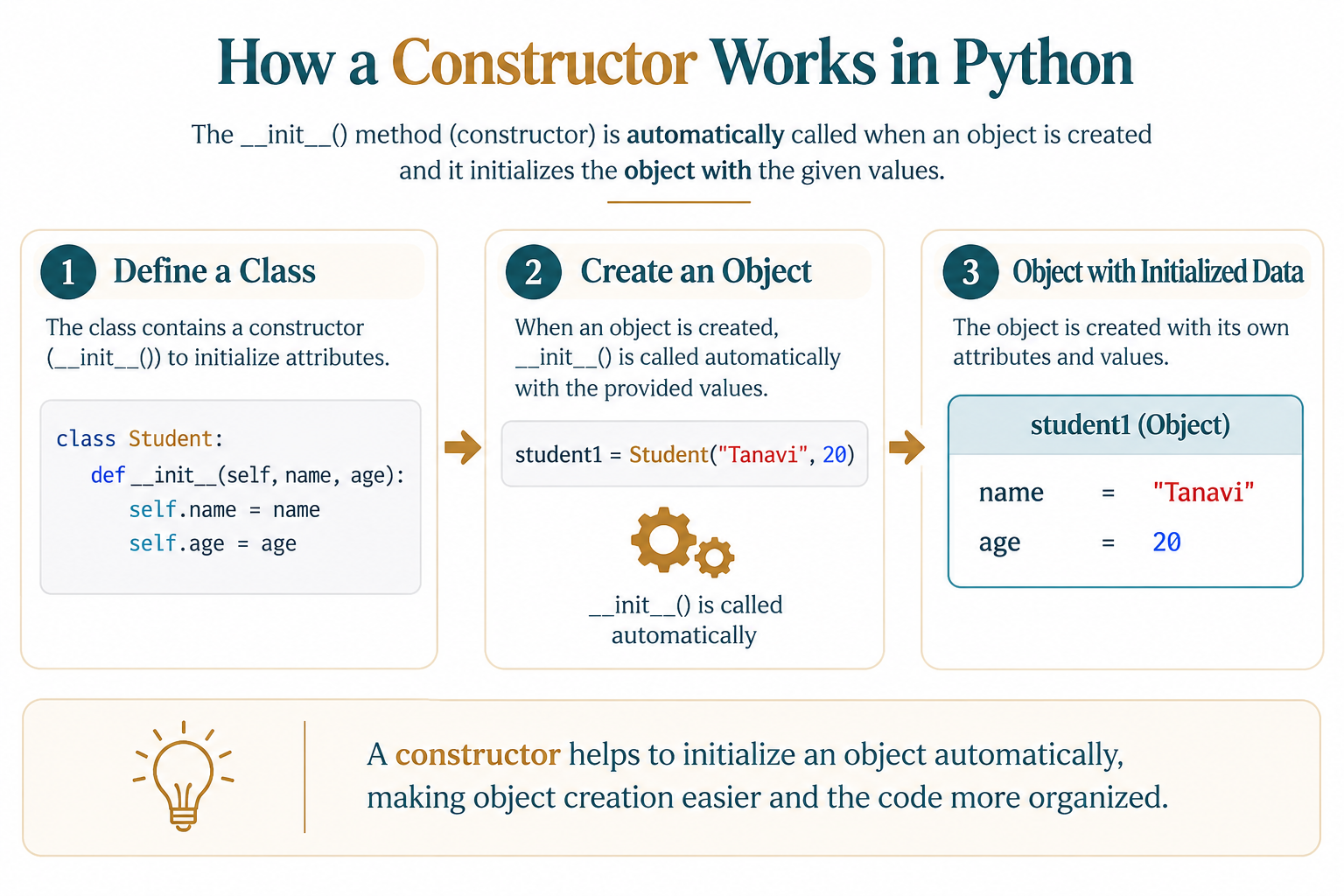
The __init__() method is automatically called when an object is created from a class. It is generally used to initialize instance attributes. The self parameter refers to the current object, allowing values to be stored in that object's attributes.
Example:
# Python program to demonstrate the __init__() method

class Student:

    def __init__(self, name):
        self.name = name


student1 = Student("Tanavi")

print(student1.name)
Output:
Tanavi
Explanation:
- The Student class is created.
- The __init__() method accepts name as an argument.
- The student1 object is created with the value "Tanavi".
- Python automatically calls __init__().
- The value is stored in self.name.
- The student's name is printed.
Syntax of a Constructor:
class ClassName:
def __init__(self, parameters):
# initialization code
Explanation:
- class: Defines a class.
- ClassName: Represents the name of the class.
- def: Defines a method.
- __init__(): The special method commonly used for object initialization.
- self: Refers to the current object.
- parameters: Values passed while creating the object.
- Initialization code: Assigns values to the object's attributes.
Constructor Without Parameters
A constructor does not always need additional parameters apart from self. Such a constructor is commonly called a non-parameterized constructor. It can be used when objects should start with predefined values.
Example:
# Python program to demonstrate a constructor without parameters

class Car:

    def __init__(self):
        self.brand = "Toyota"
        self.model = "Camry"


car1 = Car()

print(car1.brand)
print(car1.model)
Output:
Toyota
Camry
Explanation:
- The Car class is created.
- The constructor initializes the brand and model attributes.
- The car1 object is created.
- The constructor runs automatically.
- The values are assigned to the object.
- The values are printed.
Constructor with Parameters
A parameterized constructor accepts values when an object is created. This allows different objects of the same class to contain different data.
Example:
# Python program to demonstrate a parameterized constructor

class Student:

    def __init__(self, name, age):
        self.name = name
        self.age = age


student1 = Student("Tanavi", 20)
student2 = Student("Rahul", 21)

print(student1.name, student1.age)
print(student2.name, student2.age)
Output:
Tanavi 20
Rahul 21
Explanation:
- The constructor accepts name and age.
- student1 is created with "Tanavi" and 20.
- student2 is created with "Rahul" and 21.
- The constructor stores these values in the respective objects.
- Each object maintains its own data.
Constructor with Default Arguments
A constructor can also use default values for its parameters. If a value is not provided while creating an object, Python uses the default value.
Example:
# Python program to demonstrate a constructor with default arguments

class Employee:

    def __init__(self, name, department="IT"):
        self.name = name
        self.department = department


employee1 = Employee("Tanavi")
employee2 = Employee("Rahul", "HR")

print(employee1.name, employee1.department)
print(employee2.name, employee2.department)
Output:
Tanavi IT
Rahul HR
Explanation:
- The constructor accepts name and department.
- The default value of department is "IT".
- employee1 does not provide a department, so "IT" is used.
- employee2 provides "HR", so that value is stored.
- Both objects are initialized with their respective values.
Multiple Objects Using a Constructor
One constructor can be used to initialize multiple objects of the same class. Each object receives its own values and maintains its own instance attributes.
Example:
# Python program to demonstrate multiple objects using a constructor

class Product:

    def __init__(self, name, price):
        self.name = name
        self.price = price


product1 = Product("Laptop", 50000)
product2 = Product("Phone", 25000)
product3 = Product("Tablet", 30000)

print(product1.name, product1.price)
print(product2.name, product2.price)
print(product3.name, product3.price)
Output:
Laptop 50000
Phone 25000
Tablet 30000
Explanation:
- The Product class contains a constructor with name and price.
- Three objects are created from the same class.
- Each object passes different values to the constructor.
- The constructor stores those values in the corresponding objects.
- Each object can access its own attributes.
Using the self Parameter
The self parameter represents the current object. It is used to access and store instance attributes inside the class. When an object is created, self refers to that particular object.
Example:
# Python program to demonstrate the self parameter

class Student:

    def __init__(self, name, course):
        self.name = name
        self.course = course


student1 = Student("Tanavi", "BSc IT")

print(student1.name)
print(student1.course)
Output:
Tanavi
BSc IT
Explanation:
- The Student class is created.
- The constructor accepts name and course.
- self.name stores the student's name.
- self.course stores the student's course.
- When student1 is created, self refers to student1.
- The object's attributes can then be accessed using student1.name and student1.course.
Constructor with Multiple Instance Attributes
A constructor can initialize multiple instance attributes at the same time. This is useful when an object needs to store several related pieces of information.
Example:
# Python program to demonstrate multiple instance attributes

class Employee:

    def __init__(self, name, age, salary):
        self.name = name
        self.age = age
        self.salary = salary


employee = Employee("Tanavi", 20, 40000)

print("Name:", employee.name)
print("Age:", employee.age)
print("Salary:", employee.salary)
Output:
Name: Tanavi
Age: 20
Salary: 40000
Explanation:
- The Employee class is created.
- The constructor accepts three parameters.
- These values are assigned to name, age, and salary.
- The values are stored as instance attributes of the employee object.
- The attributes are accessed using the object.
- The values are displayed on the screen.
Common Beginner Mistakes
Beginners often make mistakes while defining the __init__() method and creating objects. Understanding these mistakes can help avoid common errors.
1. Forgetting self: The self parameter is required when defining an instance method such as __init__().
Wrong:
class Student:
def __init__(name, age):
name = name
age = ageCorrect:
class Student:
def __init__(self, name, age):
self.name = name
self.age = age
2. Forgetting Double Underscores: The initialization method must be written correctly as __init__() with two underscores before and after init.
Wrong:
def _init_(self):
passCorrect:
def __init__(self):
pass
3. Forgetting to Pass Required Arguments: If a constructor requires arguments, they must be provided when creating the object.
Wrong:
class Student:
def __init__(self, name):
self.name = name
student1 = Student()Correct:
student1 = Student("Tanavi")
4. Using a Variable Without self: Instance attributes should be assigned using self when they need to belong to the object.
Wrong:
class Student:
def __init__(self, name):
name = nameCorrect:
class Student:
def __init__(self, name):
self.name = name
5. Incorrect Indentation: Python uses indentation to identify the code belonging to a class and method.
Wrong:
class Student:
def __init__(self):
print("Student created")Correct:
class Student:
def __init__(self):
print("Student created")
Conclusion
Constructors are an important concept in Python object-oriented programming. They are commonly used to initialize objects when they are created.
The __init__() method allows developers to assign initial values to instance attributes and makes object initialization more organized and convenient. Constructors can work with parameters, default arguments, and multiple attributes, making them useful for building practical Python applications.
By understanding constructors and the self parameter, beginners can build a strong foundation in classes and objects. This knowledge also helps when learning advanced object-oriented programming concepts such as inheritance, polymorphism, encapsulation, and abstraction.
Frequently Asked Questions (FAQs)
1. What is a constructor in Python?
A constructor is commonly used to initialize an object when it is created. In Python, the __init__() method is commonly used for this purpose.
2. What is the purpose of __init__() in Python?
The __init__() method is used to initialize the attributes of an object when the object is created.
3. Is __init__() automatically called?
Yes. Python automatically calls the __init__() method when an object is created from a class that defines it.
4. What is the self parameter?
self refers to the current object. It is used to access and store instance attributes inside the class.
5. Can a constructor accept parameters?
Yes. A constructor can accept parameters, allowing different objects to be initialized with different values.
6. Can a Python class have multiple constructors?
Python does not support traditional constructor overloading in the same way as some other programming languages. Defining __init__() multiple times in the same class causes the latest definition to replace the previous one. Default arguments or other techniques can be used to handle different initialization requirements.
7. What happens if a class does not define __init__()?
If a class does not define its own __init__() method, Python can use the inherited initialization behavior from its parent class. A class can also create objects without explicitly defining __init__() when no custom initialization is required.

0 Comments