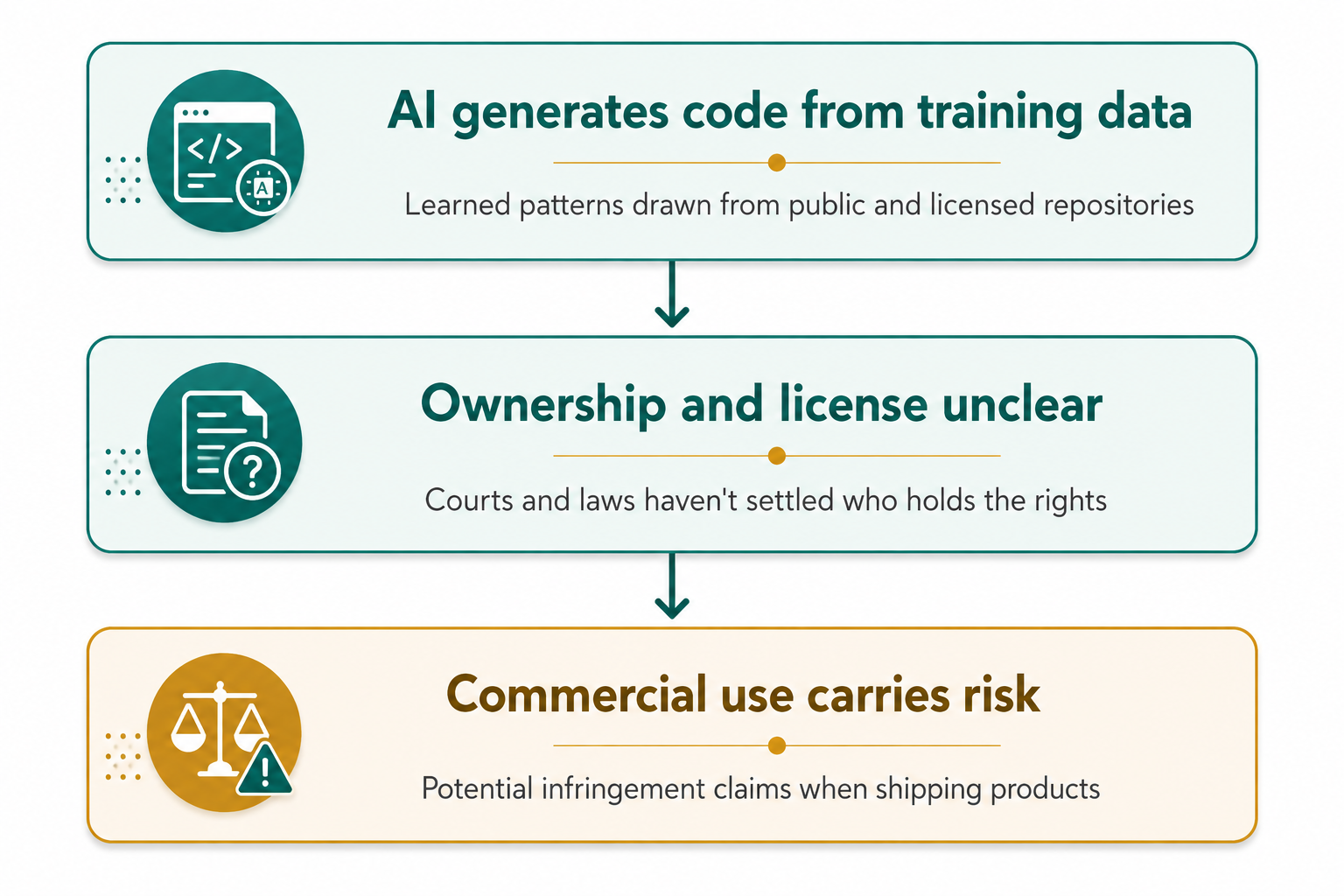
The mechanism is simple: you ask an AI tool to write some code for you, add it to your codebase, and start working on implementing your new feature. However, all this may seem routine until you encounter the real legal issue that underlies it all, including who owns the code, if anyone, and whether you are allowed to distribute the software utilizing it. And the only answer to this question will be “It depends” on something that is not very common to think about.
Table of Contents
Can You Legally Copyright AI-Generated Code?
The first question that arises in almost any situation is one legal principle: copyright applies to human works, not machines. The code that the AI generates without any human creative involvement does not fall under copyright at all. Neither yours, nor the vendor's, nor AI's. At first glance, it seems like a formal issue, but in reality, it impacts the legality of your codebase significantly.
- No Human, No Copyright: Code that is machine-generated is not covered by copyright because United States law presumes that there should be a human author of the code.
- Spectrum, not a Switch: The bigger the number of creative decisions made by the developer during the creation of the work, like architecture, corrections, restructuring, etc., the higher the chance that the copyright will apply to it.
- One-line Prompts Don't Count: The fact that the developer typed a short instruction for AI to follow does not constitute a copyright-worthy contribution.
- Public Domain has a Two-way Nature: Code without copyright can be copied by anyone else, but you cannot protect your own unaltered AI code either.
- Mixed Files get Split: When code contains elements produced by humans and machines, only the former is protected.
Human Authorship: The Line That Decides Everything
As a result, since there is such reliance on the presence of human agency within the realm of copyright, the question "how much has a person really done" comes into play in nearly all disputes and audits. It is not just a theoretical issue, but one that will determine whether your competitor can legally use your code generated by the AI system and prevent you from doing so.
- Editing Makes a Difference: Meaningful editing, refactoring, or debugging of the AI-produced code bolsters a developer's position as an author of that code.
- Architecture is Authorship: The architecture of the entire system, where AI-produced functions are used, represents an act of human creativity.
- Documentation is Proof: Documentation of prompt, edit, and design choices can be useful in demonstrating human authorship if there are any doubts about ownership.
- The Idea of "AI as Junior Developer": Considering AI-produced material as a first draft reviewed by a human and being responsible for it makes things legally safer.
- Disclosures May be Necessary: More and more copyright registration processes require disclosing what proportion of the work was done with the help of AI.
Who Owns the Code Your AI Tool Generates?
Apart from copyright legislation, there is a contractual level to consider in terms of the terms of service of whichever particular AI tool you are using. Most of the major providers give users the right to use the code generated by their products, but "the vendor grants you the rights" and "the code is copyrighted" are two completely separate issues that are often confused.
- Terms of Service Grant Rights: AI coding systems usually allow users to use their code through their terms of service, regardless of its copyright protection.
- Terms Cannot Contradict Statutory Law: Terms of service may grant users the rights to use some code, but they do not grant any copyright to something that the law does not acknowledge as one.
- Difference of Terms with Versions: Terms differ between enterprise versions and consumer versions. The paid or enterprise version of a product will have better terms of ownership than a free consumer version.
- Terms vary by Provider: The terms related to ownership and usage of code vary greatly from one provider to another.
- Ownership is not Equivalent to Originality: Having the right to use some piece of code does not automatically mean that it is a unique product.
The Open-Source Contamination Problem
These AI coding programs train on massive amounts of publicly available code, which is data that does not just vanish but rather affects the output generated by the AI. This presents a risk that is easy to overlook, which is the fact that the code created could be influenced by licensed open-source software unbeknownst to the business in question.
- Latent License Obligations: The AI-generated code can repeat patterns that are found in copyleft-licensed code without the indication of origin.
- Copyleft Propagates Through Use: Using GPL-derived code in your closed commercial project can result in a license violation even if it was done unintentionally.
- Judicial System Enforces the Terms: The conditions of the open-source license have been legally recognized as copyright and as an enforceable contract in previous cases.
- "You can't blame the AI" Doesn't Work: Violation of the copyright means liability for the distributing company rather than for the company whose software generated the code.
- Prevention Techniques Exist: There are some companies that check their AI-generated code against open-source libraries before distribution.
Commercial Use Rights Across AI Coding Tools
Not all AI coding assistants approach commercial use the same way, and it becomes much more important when the money starts rolling in. Some vendors are straightforward in their policy; others hide their restrictions in terms that developers don’t even read carefully.
- Commercial Usage Permissions: Top coding assistants explicitly mention the permission to use the generated code in commercial software, rather than only for individual use.
- Tier-based Restrictions: In some cases, the commercial use restrictions differ from tier to tier, and choosing the right one is a matter of law.
- Requirements for Attribution: In a few cases, it is required to credit the AI assistant or disclose the fact of using it when deploying a product commercially.
- Commercial Use Audit: Some vendors retain the right to audit the way the generated content is used in commercial deployment.
- Changing Terms: Companies regularly revise their commercial use policies, which means that your team’s understanding of the rules may be outdated.
Where Liability Actually Lands
In cases where something does happen, for instance, infringement, license violation, security problems attributable to copied code, the issue of legal accountability quickly and directly arises. There is consistency in the existing laws and ongoing litigation despite the exact boundaries being currently defined by courts.
- The Distributor Assumes the Risk: Those who distribute and sell the software are usually those who face liability for the infringement, rather than the vendor of the AI tool.
- Litigation Defines New Norms: Current lawsuits against some major providers of AI-based coding are actively exploring the extent of responsibility for the tools' outcomes.
- Contractual Liability is More Durable than Copyright: Some legal actions related to reproduced code survived in court despite copyright actions that got dismissed.
- "I didn't know" is of Little Help: Ignorance of embedded license requirements will not protect a company from its implications.
- Risk Depends on Distribution: Internal usage is much safer than selling software to customers or releasing it to the public.
Vendor Mistake Protection: What It Covers
To address this situation, some AI vendors now provide an option of indemnification, which is essentially an undertaking to cover some legal expenses in case the product's output causes a client to be sued. While the notion seems very encouraging, in reality, the coverage can turn out to be much more limited than expected.
- Conditions Apply: The indemnification clause usually operates under conditions of customers using the product according to its intended purpose and limitations.
- Limited Scope: Some policies do not cover code identified as public code or produced with filters turned off.
- Exclusive for Enterprises: The best possible coverage is often available only at the enterprise and business levels of pricing.
- No Magic Solution: While the indemnification clause will cover legal expenses in case of disputes, it will not retroactively create a copyright for uncopyrightable material.
- Better Verify Directly: Because different vendors have different policies that might change, it is always better to verify indemnification terms firsthand.
Best Practices for Commercial AI-Generated Code
Despite the uncertainties, legally prudent firms do not shun the use of coding AI; they develop a process based on their use. A few key practices can be observed among those firms that utilize the tool for commercial purposes in a risk-free way.
- Review Before You Release: Considering the AI output to be a draft version of code, which is subsequently reviewed and edited by a human, strengthens any subsequent claims of ownership.
- Look for License Matches: Going over generated code using tools that scan for the presence of open source elements helps to prevent any contamination from getting to the production stage.
- Create Human Contribution History: Documenting changes made, prompts used, and design choices made leaves an evidence chain in case of any authorship dispute.
- Select Commercially-clear Tools: Choosing an AI code generation platform with clear and positive commercial terms avoids problems right away.
- Consult Legal Upfront: It will cost less to consult legal regarding vendor terms for the use of any code going into the product at any significant scale.
Common Mistakes Businesses Make
Despite the best intentions, there are only a few mistakes that people make when it comes to working on teams. Most of them stem from the assumption that AI code is equivalent to human code from a legal perspective, which is not the case right now.
- Assuming Automatic Ownership: The mistaken belief that payment for the tool equates to copyrighting the created work is a mistake that leads to serious problems.
- Neglecting to Check for Licenses: One of the most common legal issues happens when the created code is shipped without being checked for any licensing.
- Neglecting Tier Limitations: The mistake of assuming that because the tool is free, it can be used commercially without checking its capabilities first.
- Assuming Disclosure is Unnecessary: Not disclosing the use of the software where necessary, be it the registration of the work or the client contract.
- Believing in the Current Law: The assumption that everything is clear and can be used for business without following the litigation.
How International Copyright Rules Differ
All of the above represent the present approach by the U.S., but a worldwide business cannot end its efforts at that point because copyright laws covering computer programs created using AI technology are not universal; a program used internationally could come under different laws based on which jurisdiction resolves any dispute over that program.
| Region | Approach | What It Means in Practice |
|---|---|---|
| United States | Requires meaningful human authorship | Purely AI-generated code is denied copyright protection outright |
| United Kingdom | Recognizes computer-generated works | Copyright can be assigned to the person who arranged for the code's creation |
| European Union | Standard still unsettled | Member states apply human-originality requirements inconsistently |
| Cross-border enforcement | Follows distribution, not creation | The country where a product is sold or used often matters more than where the code was generated |
| Multi-market businesses | No single global standard | Copyright treatment should be checked per jurisdiction, not assumed from the home market |
Contract Clauses to Watch For in Client Work
Freelancers, agencies, and vendors who provide AI-enhanced code to clients have an extra dimension of risk associated with them, as they sign off on traditional, human-delivered contractual agreements.
- "Original work" Clause: Many contracts require the deliverable to be the original work of the vendor, a commitment that gets challenged when the code is significantly produced by AI.
- IP Assignment Clause: Common "all rights" clauses presume the presence of such rights and assume that the work can be assigned.
- AI Tool Disclosure Clause: More and more contracts explicitly mention the use of AI tools.
- Indemnity Commitments: The client might ask for indemnity against infringement claims even though the root of the risk was caused by using third-party tools.
- Updating Old Contracts: It is beneficial to look at the language of those agreements made prior to the widespread adoption of AI-enhanced work processes.
Conclusion
A simple “can you use AI-generated code commercially” answer would be a clear yes, but what really matters is the more complicated situation, which no one really understands. There is copyright protection only when there is some actual human work behind it; ownership is determined by the vendor’s license (which may differ greatly), and liability for any mishap falls on those who shipped the product, not the developers of the AI. It does not mean that there is some risk in using AI coding assistants commercially; it just means that the smartest companies will treat the generated code just like any other draft.
Frequently Asked Questions
1. Can I copyright code that an AI wrote for me?
Only the portions that involved meaningful human creative input; code an AI-generated with no substantial editing or design contribution generally isn't protectable on its own.
2. Does paying for an AI coding tool give me full ownership of its output?
It usually grants you contractual rights to use the code commercially, but that's separate from copyright, a paid subscription doesn't make uncopyrightable code copyrightable.
3. Can I get sued for using AI-generated code in a commercial product?
Yes, if the generated code reproduces licensed open-source material without complying with that license, the company distributing the product typically carries the legal risk.
4. Does vendor indemnification fully protect my business from legal risk?
Not entirely; indemnification often comes with conditions, tier restrictions, and exclusions, so it reduces risk rather than eliminating it.
5. Is the law around AI-generated code likely to change soon?
Very possibly because multiple related lawsuits and regulatory questions are still active, so current rules could shift as courts issue new rulings.

0 Comments