The elif ladder in Python is used when you need to check multiple conditions one after another. Instead of writing multiple separate if statements, an elif ladder allows you to test several conditions in a structured way. As soon as one condition evaluates to True, Python executes the corresponding block and skips the remaining conditions. The elif statement is short for "else if", making it an efficient way to handle multiple decision-making scenarios.
Table of Contents
What is an Elif Ladder?
An elif ladder is a sequence of if, one or more elif, and an optional else statement. Python evaluates each condition from top to bottom.
- If the if condition is True, its block executes.
- Otherwise, Python checks the first elif.
- If that condition is False, it moves to the next elif.
- This process continues until a condition becomes True.
- If none of the conditions are true, the else block executes (if present).
Only one block from the ladder is executed.
Syntax:
if condition1:
# Code block
elif condition2:
# Code block
elif condition3:
# Code block
...
else:
# Default block
Flowchart of Elif Ladder
The flowchart shows how the if-elif-else ladder evaluates multiple conditions one by one until it finds the first condition that is True. Once a matching condition is found, Python executes its corresponding block and skips all remaining conditions.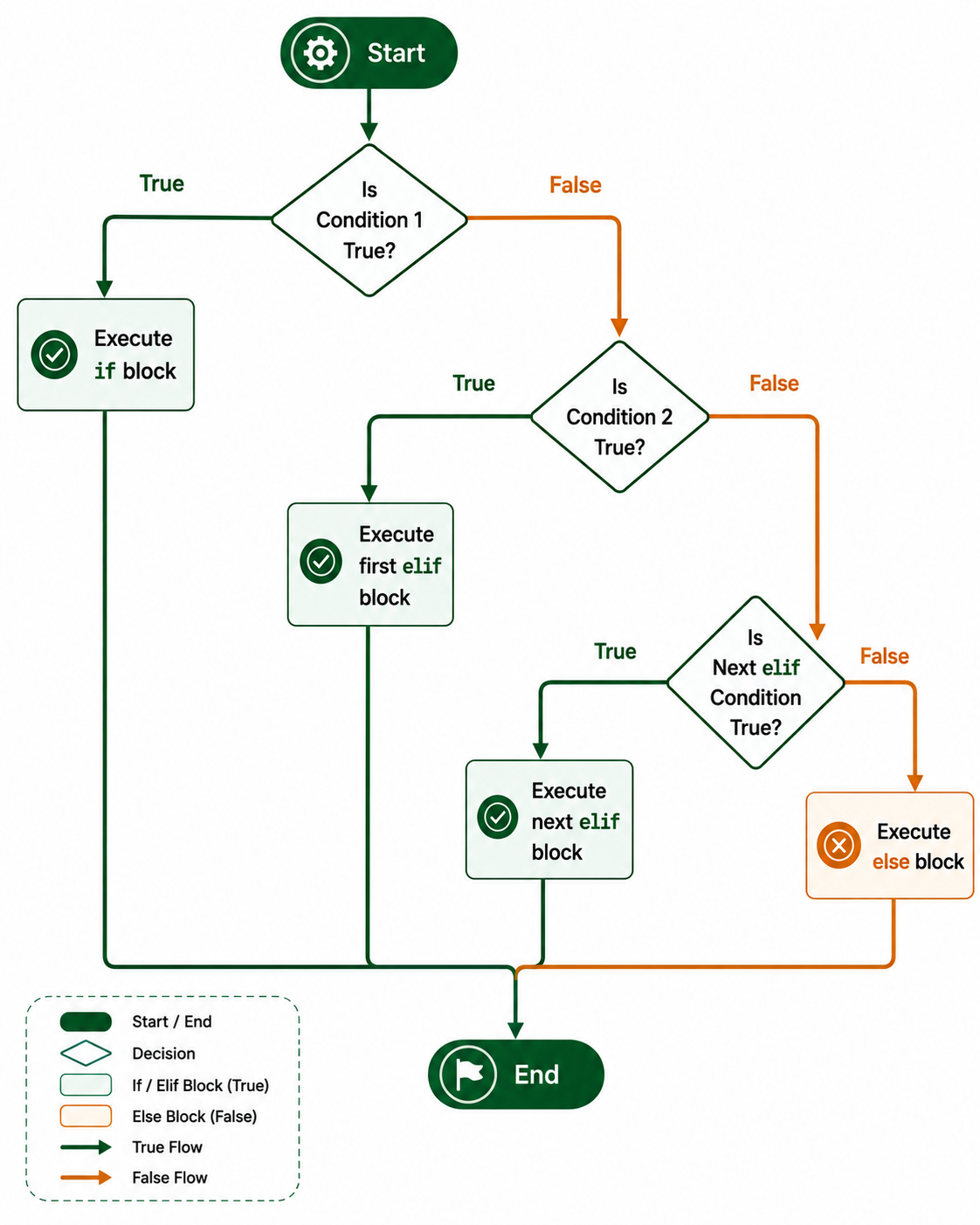
Step 1: Start the Program: The program begins execution and reaches the first if statement.
Step 2: Evaluate the First Condition: Python checks Condition 1. This is the first condition in the if statement.
Step 3: Execute the if Block: If Condition 1 evaluates to True, Python executes the statements inside the if block and skips all the remaining elif and else blocks.
Step 4: Check the First elif Condition: If Condition 1 evaluates to False, Python moves to the first elif statement and evaluates **Condition 2`.
Step 5: Execute the First elif Block: If Condition 2 evaluates to True, Python executes the statements inside the first elif block and skips the remaining elif and else blocks.
Step 6: Check the Remaining elif Conditions: If Condition 2 is also False, Python continues checking each remaining elif condition one by one until it finds a condition that evaluates to True.
Step 7: Execute the Matching elif Block: When any elif condition evaluates to True, Python executes the corresponding elif block and ignores all subsequent elif and else blocks.
Step 8: Execute the else Block: If none of the if or elif conditions evaluate to True, Python executes the statements inside the else block.
Step 9: Continue Program Execution: After executing the appropriate if, elif, or else block, Python exits the if-elif-else ladder and continues executing the remaining statements in the program.
Example of Elif Ladder: Checking Student Grade
# Python program to demonstrate Elif Ladder
marks = 82

if marks >= 90:
    print("Grade A")
elif marks >= 75:
    print("Grade B")
elif marks >= 60:
    print("Grade C")
elif marks >= 40:
    print("Grade D")
else:
    print("Fail")
Output:
Grade B
Explanation:
- The first condition is false because 82 is not greater than or equal to 90.
- The second condition is true because 82 is greater than or equal to 75.
- Python prints Grade B and skips all remaining conditions.
Conclusion
The elif ladder in Python is an essential decision-making structure used to evaluate multiple conditions in sequence. It makes programs more organized, readable, and efficient by ensuring that only the first matching condition is executed. Whether you are developing grading systems, calculators, authentication modules, or menu-driven applications, mastering the elif ladder will help you write cleaner and more maintainable Python programs.Frequently Asked Questions
1. What does elif stand for?
elif stands for "else if". It is used after an if statement to test additional conditions when the previous conditions are false.
2. Can an elif ladder exist without an else block?
Yes. The else block is optional. If none of the conditions are true and there is no else, the program simply skips the entire ladder.
3. Can multiple elif conditions execute?
No. Only the first condition that evaluates to True is executed. Python ignores the remaining elif and else blocks.
4. Is there a limit to the number of elif statements?
No. Python does not impose a fixed limit on the number of elif statements, although using too many may make the code difficult to read and maintain.
5. Can I use nested if statements inside an elif block?
Yes. You can place if, elif, or else statements inside an elif block whenever additional decision-making is required. This is known as nested conditional statements and is useful for handling more complex logic.

0 Comments