Data Structures and Algorithms (DSA) can be difficult to learn because understanding a concept is different from applying it to a new problem. You may know what a HashMap, binary search, or dynamic programming is, but still struggle to identify when and how to use it.
AI can make DSA practice more effective by acting as a personal tutor, coding assistant, debugger, and mock interviewer. However, the goal should not be to let AI solve every problem. Instead, AI should help you develop your own problem-solving ability.
Table of Contents
How Can AI Help You Practice DSA?
AI can be a useful learning partner for DSA practice when you use it to improve your thinking rather than simply get answers. Here are five practical ways it can help.
- Get Guidance When You Are Stuck: Instead of asking AI to solve a problem immediately, ask for a hint or the next step. AI can point you toward the right data structure or technique without revealing the complete solution.
- Understand DSA Patterns: AI can help you identify common patterns such as sliding window, two pointers, binary search, recursion, dynamic programming, and graph traversal. Over time, this can help you recognize which approach may fit a new problem.
- Debug Your Code: When your solution produces the wrong output, AI can help you inspect the logic, identify possible bugs, and explain why a particular test case fails. You should still try to understand and fix the issue yourself.
- Test Your Solution: AI can generate edge cases and unusual inputs that you may not have considered. Testing against these cases can help you find weaknesses in your implementation.
- Review and Improve Your Approach: After solving a problem, you can ask AI to review your approach, analyze its time and space complexity, and compare it with alternative solutions. This helps you learn how different approaches work and when one may be more efficient than another.
AI can explain complex DSA concepts using simple explanations and real-world examples.
For example, instead of only asking "What is a stack?", ask:
A stack can be compared to a pile of plates: the last plate placed on top is the first one removed."Explain Stack using a real-world example, explain LIFO, its operations, and their time complexity."
Ask AI for Hints Instead of Solutions
When you get stuck on a DSA problem, don't immediately ask AI for the complete solution. Instead, ask for a hint that helps you take the next step yourself.
Instead of:
Try:"Solve Two Sum in Java."
This keeps you involved in the problem-solving process. You can also ask AI whether a particular approach or pattern is worth exploring. This keeps you actively involved in the problem-solving process while still giving you help when you need it."Give me one hint for Two Sum without revealing the solution."
The goal is to use AI as a guide, not a shortcut to the final answer.
Use AI for Pattern Recognition
Many DSA problems look different on the surface but follow the same underlying patterns. A major DSA skill is recognizing patterns. AI can help you identify patterns such as sliding window, two pointers, binary search, recursion, dynamic programming, or graph traversal.
After solving a problem, ask:
"What DSA pattern does this problem use, and what clues in the question indicate that pattern?"
Example:
| Problem Clue | Possible Pattern |
| Sorted Array | Binary Search |
| Subarray/substring | Sliding Window |
| Fast lookup | HashMap |
| Matching brackets | Stack |
This helps you connect problem features with the right technique. Over time, you will start recognizing these patterns yourself instead of treating every new problem as completely unfamiliar.
Debug Your Own Code
Debugging is an important part of DSA practice because a solution that looks correct may still fail for certain inputs. When your code produces an unexpected output, AI can help you examine your logic, identify possible mistakes, and understand why a particular test case fails. However, instead of asking AI to rewrite the entire solution, you should use it to understand the error and fix the code yourself.
For example, consider the following code for finding the maximum element in an array:
At first glance, the code appears correct, but it fails when the array contains only negative numbers, such as [-10, -5, -20]. The expected answer is -5, but the code returns 0 because max is initialized to 0.int max = 0;
for (int x : arr) {
if (x > max)
max = x;
}
Instead of immediately asking AI to provide the corrected code, you can ask:
This approach helps you understand why the code fails and encourages you to identify and fix similar mistakes on your own. Over time, using AI in this way can improve your debugging skills rather than making you dependent on AI-generated solutions."Find the logical error in my code and give me a test case that exposes it. Don't fix it yet."
Generate Edge Cases
A solution that works correctly for the normal inputs may still fail when it encounters an unusual or unexpected case. This is why testing edge cases is an important part of DSA practice. While solving a problem, it is easy to focus on the examples given in the question and overlook inputs that could expose weaknesses in your logic. AI can help by generating these cases and encouraging you to think beyond the obvious examples.
For example, after writing your solution for an array problem, you can ask AI:
"Generate edge cases for this DSA problem without providing the solution."
AI can suggest cases such as an empty input, an array containing a single element, duplicate values, negative numbers, sorted or reverse-sorted input, and input containing the maximum number of elements allowed by the constraints.
You can then test your code against these cases and check whether it produces the expected results. This not only helps identify bugs and boundary conditions but also improves your ability to think about different scenarios before submitting a solution, which is especially useful during coding interviews.
Analyze Time and Space Complexity
A solution is not considered efficient simply because it produces the correct output. In DSA, it is also important to understand how much time and memory an algorithm requires as the input size increases. This is where time and space complexity become important. AI can help you analyze your solution and understand how different parts of your code contribute to its overall complexity.
For example, consider the following code:
for (int i = 0; i < n; i++) {
for (int j = 0; j < n; j++) {
// operation
}
}
The outer loop runs n times, and for each iteration, the inner loop also runs n times. Therefore, the operation is performed approximately n × n times, resulting in a time complexity of O(n²). Since the code does not use any additional data structure that grows with the input, its extra space complexity is O(1).
You can ask AI:
Once you understand the complexity of your solution, you can take the learning one step further by asking:"Analyze the time and space complexity of my code and explain how you calculated it."
"My solution is O(n²). Give me a hint for finding a more efficient approach."
This helps you understand not only the complexity of your solution but also how you can improve your problem-solving approach and choose more efficient algorithms.
Compare Different Approaches
Many DSA problems can be solved using more than one approach. Comparing these approaches helps you understand the trade-offs between execution time, memory usage, and implementation complexity.
For example, when solving a problem such as Two Sum, you can ask AI:
A comparison can look like this:"Compare the brute-force, sorting, and HashMap approaches. Explain their time complexity, space complexity, and trade-offs."
| Approach | Time Complexity | Space Complexity |
| Brute Force | O(n2) | O(1) |
| Sorting | O(n log n) | O(1)* |
| HashMap | O(n) | O(n) |
This comparison helps you understand why an optimized approach may be preferred when working with large inputs.
Practice Mock Interviews
Preparing for a DSA interview involves more than solving problems. You also need to explain your approach clearly and answer questions about your decisions. AI can simulate a technical interviewer and help you practice this part of the process.
You can use a prompt such as:
"Act as a DSA interviewer. Give me one medium-level problem. Don't provide hints unless I ask."
During the mock interview, AI can ask questions about your approach, algorithm selection, time and space complexity, edge cases, and possible optimizations. This allows you to practice both problem-solving and communication skills before an actual interview.
Create a Personalized Practice Plan
A DSA practice plan becomes more effective when it is based on your current skill level, available study time, and weaker topics. AI can help you create a structured roadmap instead of following the same plan as everyone else.
For example, you can ask AI:
"Create a 30-day DSA practice plan based on my available time and weak areas. Include topics, revision days, and mock interviews."
A plan could look like this:
You can also ask AI to adjust the plan as you progress, generate revision schedules, or suggest additional problems based on the mistakes you have made. This makes your preparation more focused and helps you spend more time on the topics where you need improvement.Week 1 → Arrays, Strings, Hashing
Week 2 → Linked List, Stack, Queue
Week 3 → Trees, Graphs, Recursion
Week 4 → Dynamic Programming + Mock Interviews
Maintain a DSA Mistake Log
Making mistakes is a normal part of learning DSA, but forgetting those mistakes can lead to repeating them. Keeping a mistake log helps you identify patterns in your errors and understand what you need to improve. AI can also help organize these mistakes and suggest similar problems for practice.
Example:
Problem: Two Sum
Mistake: Used nested loops
Pattern missed: Hashing
Correct insight: Store previously seen values
Lesson: Consider HashMap when fast lookup is required
You can ask AI to turn your mistakes into a short revision list or recommend similar problems based on the patterns you missed. Over time, this makes your practice more focused and helps you avoid repeating the same mistakes.
A Smart AI-Assisted DSA Workflow
Using AI effectively in DSA practice is not about asking for the solution at every step. A better approach is to use AI at different stages of the problem-solving process while keeping the actual thinking and coding in your hands.
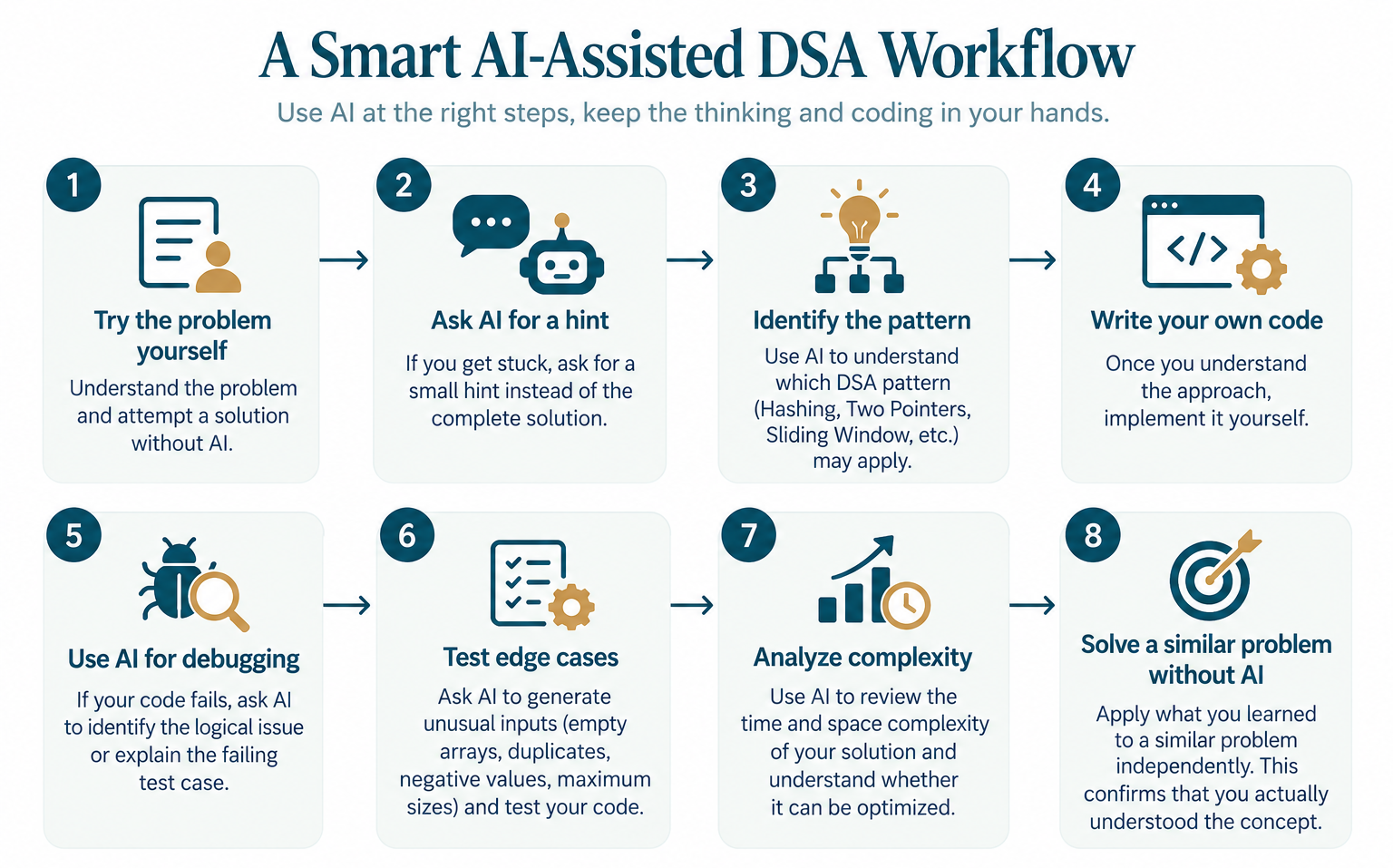
A simple workflow is:
- Try the problem yourself: Start by understanding the problem and attempting a solution without AI. This helps you develop your own reasoning.
- Ask AI for a hint: If you get stuck, ask for a small hint instead of the complete solution. This gives you direction without removing the problem-solving challenge.
- Identify the pattern: Use AI to understand which DSA pattern, such as Hashing, Two Pointers, Sliding Window, or Binary Search, may apply to the problem.
- Write your own code: Once you understand the approach, implement it yourself. This is where you build actual coding skills.
- Use AI for debugging: If your code fails, ask AI to identify the logical issue or explain the failing test case rather than rewriting the entire solution.
- Test edge cases: Ask AI to generate unusual inputs, such as empty arrays, duplicates, negative values, or maximum-sized inputs, and test your code against them.
- Analyze complexity: After your solution works, use AI to review its time and space complexity and understand whether it can be optimized.
- Solve a similar problem without AI: Finally, apply what you learned to a similar problem independently. This confirms that you actually understood the concept.
What Should You Avoid When Using AI?
AI can make DSA practice easier, but using it too much can weaken your own problem-solving skills. The key is to use AI for guidance and verification, not as a replacement for thinking.
- Don't Copy Solutions Blindly: Avoid copying AI-generated code without understanding how it works. Make sure you can explain the approach and write the solution yourself.
- Don't Ask for the Answer First: Attempt the problem before turning to AI. If you're stuck, start with a hint rather than asking for the complete solution.
- Don't Assume AI Is Always Correct: AI can produce incorrect code, explanations, or approaches. Test the suggested solution and verify the reasoning before relying on it.
- Don't Ignore Complexity: A solution that works is not necessarily an efficient solution. Always check its time and space complexity and consider whether a better approach exists.
- Don't Depend on AI for Every Decision: Try to choose the data structure, pattern, and initial approach yourself. Use AI when you genuinely need guidance or want to review your reasoning.
- Don't Skip Your Mistakes: After solving a problem, understand what went wrong if your first attempt failed. Learning from mistakes is an important part of becoming better at DSA.
Conclusion
AI can make DSA practice more interactive and personalized. It can explain difficult concepts, provide hints, identify patterns, debug code, generate edge cases, analyze complexity, create practice plans, and simulate technical interviews.
However, AI should support your thinking, not replace it. The most effective approach is to attempt a problem yourself first and use AI only when you genuinely need assistance.
The ultimate goal of AI-assisted DSA practice is not to become better at asking AI for solutions. It is to become better at solving problems independently.
Frequently Asked Questions (FAQs)
1. Can AI solve DSA problems for me?2. How should I use AI when I am stuck on a DSA problem?Yes, AI can generate complete solutions, but using it this way for every problem is not recommended. It is better to attempt the problem yourself first and use AI for hints, debugging, explanations, and optimization.
Start by asking for a small hint instead of the complete solution. If you are still stuck, ask AI to explain the relevant pattern or data structure. This allows you to continue solving the problem yourself.3. Can AI help me improve my DSA problem-solving skills?
Yes. AI can help you understand patterns, analyze mistakes, generate similar problems, test edge cases, and explain different approaches. However, your own practice and reasoning are still essential.4. Is it safe to trust AI-generated DSA code?
Not completely. AI can sometimes generate incorrect logic, miss edge cases, or provide an incorrect complexity analysis. You should always test the code and verify the explanation before accepting the solution.5. Can AI help with coding interview preparation?
Yes. AI can act as a mock interviewer, provide DSA questions, ask follow-up questions, evaluate your approach, and help you practice explaining time and space complexity.6. Should beginners use AI while learning DSA?
7. What is the best way to use AI for DSA practice?Beginners can use AI, but they should avoid becoming dependent on it. It is better to first understand the fundamentals and attempt problems independently, then use AI when additional guidance is needed.
A good approach is to try the problem yourself, ask for a hint when stuck, write your own solution, use AI for debugging and complexity analysis, and finally solve a similar problem without AI.

0 Comments