When you write code in Python, you are constantly dealing with data. The most direct, raw form of that data written directly into your source code is called a literal. Think of literals as the values themselves, rather than the variables holding them. For instance, in the statement x = 42, x is the variable, but 42 is the literal. Literals make programs easier to read and understand because they clearly indicate the values being used.
Table of Contents
What are Literals?
A literal is a constant value assigned to a variable or used directly in an expression. Unlike variables, literals do not change during program execution. Python classifies literals into several distinct types based on the data they represent.
- Represent Constant Values: Literals are fixed values written directly in the source code. Their value does not change while the program is running.
- Used to Initialize Variables: Literals are commonly assigned to variables to store data such as numbers, text, or Boolean values.
- Can Be Used Directly in Expressions: A literal does not always need to be stored in a variable. It can be used directly in arithmetic, comparison, or logical expressions.
- Support Multiple Data Types: Python provides different types of literals, including numeric, string, Boolean, special (None), and collection literals such as lists, tuples, dictionaries, and sets.
- Improve Code Readability: Using appropriate literals makes Python code easier to understand because they clearly represent the actual values being used in the program.
Characteristics of Literals
To understand how Python handles data at its most fundamental level, it helps to look at the core characteristics of literals. These are the underlying rules and behaviors that dictate how Python interprets raw values in your code.
1. Immutability (For Basic Types)
Most basic literals in Python are immutable, meaning their value cannot be altered once they are created in memory.
- When you write x = 5 and then x = 6, you haven't changed the literal 5 into 6. Instead, you created a new integer literal 6 and reassigned the variable x to point to it.
- Numeric, string, tuple, and Boolean literals are all strictly immutable.
2. Fixed Values During Runtime
Literals represent constant, hardcoded values evaluated at compile/interpretation time.
Unlike variables or expressions (e.g., x + y), a literal's value is explicit and unchanging throughout the execution of the program. 21 will always be 21.
3. Automatic Type Inference
Python is dynamically typed, meaning you don't have to explicitly declare what type of data a literal is. Python infers the data type automatically based on the literal's syntax:
- Text in quotes ("abc") is instantly recognized as a str.
- Numbers with a decimal point (5.0) are instantly recognized as a float.
- Numbers without a decimal point (5) are recognized as an int.
For literal collections (lists, tuples, dictionaries, sets), the type of bracket and syntax used directly defines the characteristics of that collection:
- [1, 2, 3]: Square brackets define a mutable List literal.
- (1, 2, 3): Parentheses define an immutable Tuple literal.
- {1, 2, 3}: Curly braces with single values define a Set literal.
- {"a": 1}: Curly braces with key-value pairs define a Dictionary literal.
Python literals that rely on keywords are strictly case-sensitive. For Example,
- The Boolean literals must be written exactly as True and False. Writing true or FALSE will result in a runtime error because Python looks for a variable with that name instead of recognizing it as a literal value.
- The special literal None follows the same rule.
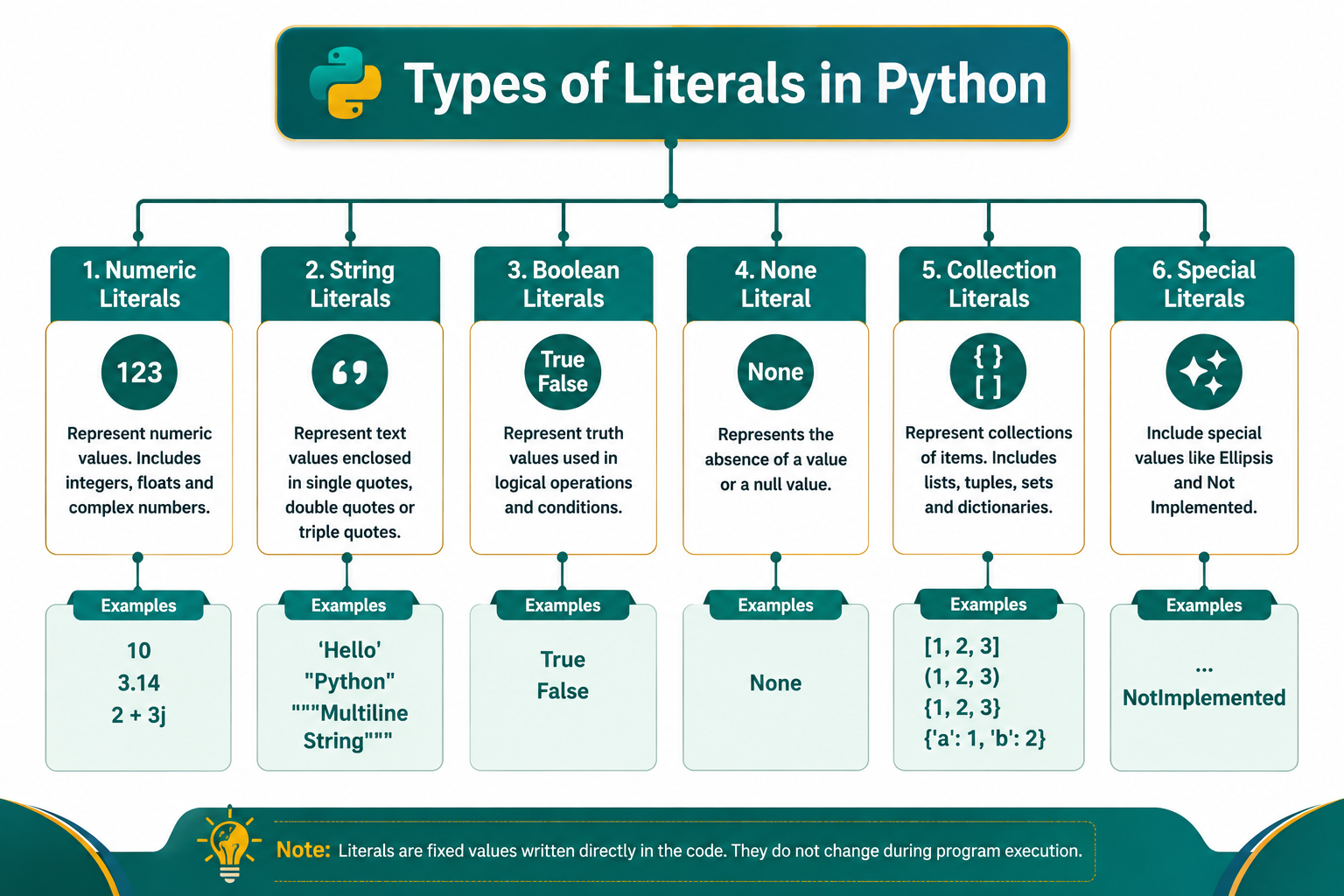
Numeric Literals
Numeric literals are immutable (unchangeable) values that represent numbers. Python supports three subtypes here:
1. Integers (Whole Numbers)
Integer literals can be positive or negative whole numbers without any fractional part. Python allows you to write integers in multiple number systems:
- Decimal (Base 10): Decimal literals use the digits 0 to 9 and represent numbers in the standard number system used in everyday calculations, such as 10, -20, and 332.
- Binary (Base 2): Binary literals use only the digits 0 and 1 and are prefixed with 0b or 0B; for example, 0b1010 represents the decimal value 10.
- Octal (Base 8): Octal literals use the digits 0 to 7 and are prefixed with 0o or 0O; for example, 0o12 represents the decimal value 10.
- Hexadecimal (Base 16): Hexadecimal literals use the digits 0 to 9 and the letters A to F (or a to f) and are prefixed with 0x or 0X; for example, 0x1A represents the decimal value 26.
You can use underscores to make large numbers readable! Python ignores them. For example, 1_000_000 is exactly the same as 1000000.
2. Floating-Point Literals (Real Numbers)
Floats represent real numbers and contain a decimal point or an exponential sign (e or E).
- Standard Decimal: Example, 3.14, -0.12, 10.0
- Exponential Notation: 2e3 (which means 2 * 103 or 2000.0)
3. Complex Literals
Python natively supports complex numbers. They are written in the form real + imaginary j, where j represents sqrt(-1).
Example: 3 + 5j or 2j
2. String and Character Literals
A string literal is a sequence of characters surrounded by quotes. Python treats single quotes (') and double quotes (") exactly the same.
- Single/Double Quotes: String literals enclosed in single (' ') or double (" ") quotes are used to represent a single-line string, such as 'Hello' or "Python".
- Triple Quotes (''' or """): String literals enclosed in triple quotes are used to represent multi-line strings or to write docstrings in Python.
3. Boolean Literals
Boolean literals represent truth values and are fundamental for logic and decision-making in code. Python has exactly two Boolean literals:
- True: The Boolean literal True represents a logical true value and is commonly used when a condition is satisfied or evaluates to true.
- False: The Boolean literal False represents a logical false value and is used when a condition is not satisfied or evaluates to false.
Python is case-sensitive, so true or FALSE will result in NameError.
4. Special Literals
Python features one special literal used to signify the absence of a value or a null value: None.
It doesn't mean 0 or False; it represents a void or a placeholder.
For example, a function that doesn't explicitly use a return statement automatically returns None.
5. Literal Collections
Python also allows you to declare entire collections of data directly using specific syntactic literals.
|
Collection Type |
Syntax / Bracket Type |
Example Literal |
|
List (Ordered, mutable) |
Square brackets [ ] |
[1, 2, "three", True] |
|
Tuple (Ordered, immutable) |
Parentheses ( ) |
(10, 20, 30) |
|
Dictionary (Key-Value pairs) |
Curly braces { } with colons |
{name: Neelesh, "age": 21} |
|
Set (Unordered, Unique items) |
Curly braces { } |
{1, 2, 3} |
Understanding Literals through Python Code
Here is a complete Python code demonstrating all 5 primary types of Python literals, followed by a detailed breakdown of how each one works.
# Python program to understand different types of literals

# 1. Numeric Literals
age = 25                  # Integer
pi = 3.14159              # Float
distance = 1_000_000      # Integer with underscores for readability

# 2. String Literals
greeting = "Hello, World!"
multiline = """This is
Multiline string
literal"""

# 3. Boolean Literals
is_python_fun = True
is_raining = False

# 4. Special Literal
database_connection = None

# 5. Literal Collections
skills_list = ["Python", "SQL", "Git"]          # List literal
coordinates = (40.7128, -74.0060)              # Tuple literal
user_profile = {"username": "dev_jay", "id": 9} # Dictionary literal
distinct_numbers = {1, 2, 3}                    #Set Literal

# --- Printing Outputs ---
print("--- 1. Numeric Literals ---")
print("Age: ", age, "| Pi: ", pi, "| Distance: ", distance)

print("\n--- 2. String Literals ---")
print(greeting)
print(multiline)

print("\n--- 3. Boolean Literals ---")
print("Is Python fun? ", is_python_fun)

print("\n--- 4. Special Literal ---")
print("Connection Status: ", database_connection)

print("\n--- 5. Literal Collections ---")
print("List: ", skills_list)
print("Tuple: ", coordinates)
print("Dictionary: ", user_profile)
print("Set: ", distinct_numbers)
Output:
--- 1. Numeric Literals ---
Age: 25 | Pi: 3.14159 | Distance: 1000000
--- 2. String Literals ---
Hello, World!
This is
Multiline string
literal
--- 3. Boolean Literals ---
Is Python fun? True
--- 4. Special Literal ---
Connection Status: None
--- 5. Literal Collections ---
List: ['Python', 'SQL', 'Git']
Tuple: (40.7128, -74.006)
Dictionary: {'username': 'dev_jay', 'id': 9}
Set: {1, 2, 3}
Explanation
- Numeric Literals: 25 is a standard base-10 integer literal. 3.14159 is a floating-point literal because it contains a decimal point. 1_000_000 demonstrates how underscores act as a visual separator for large numbers, which Python automatically ignores, printing it simply as 1000000.
- String Literals: "Hello, World!" is a standard single-line string literal enclosed in double quotes. """This is Multiline string literal""" utilizes triple quotes, allowing the string literal to physically span multiple lines in the source code without using explicit \n escape tokens.
- Boolean Literals: True and False are the only two built-in Boolean values. They represent truth states and are perfectly case-sensitive.
- Special Literal: None is assigned to the variable database_connection. It acts as a deliberate placeholder literal to show that the variable currently contains no value or data.
- Literal Collections: Instead of building collections piece by piece, we declare them instantly using structural brackets. [...] evaluates directly to a mutable list literal, (...) forms an immutable tuple literal, and {...} containing key-value pairs creates a dictionary literal.
Conclusion
Literals are the building blocks of Python programs. They represent fixed values that are directly written in the code and help programmers store and manipulate data efficiently. Python supports various types of literals, including numeric, string, Boolean, None, and collection literals. Understanding literals is essential because they form the foundation of variables, expressions, and data structures used throughout Python programming.
Frequently Asked Questions
1. What is the difference between a literal and a variable?2. Is None the same as 0 or an empty string ""?A literal is the actual raw value itself (e.g., 21 or "Hello"), whereas a variable is a named identifier or container that stores that value (e.g., x = 21, where x is the variable). Literals are hardcoded directly into the script.
3. Why does Python have both single (') and double (") quotes for strings?No. 0 is an integer literal and "" is an empty string literal - both represent specific types of data. None is a special literal of the NoneType class that represents the total absence of a value or a null status.
4. Can a tuple literal be written without parentheses?Functionally, they are identical. However, having both allows you to embed one type of quote inside a string without using escape characters. For example: "It's a beautiful day" or 'He said, "Hello" '.
5. Does Python have a character literal type?Yes, Parentheses are actually optional for tuples in many contexts. Writing x = 1, 2, 3 creates a tuple literal identical to x = (1, 2, 3). This is known as tuple packing. The only exception is an empty tuple, which must be written as ().
No. Unlike languages like C++ or Java, Python does not have a distinct "character" data type. A single character like 'a' is treated simply as a string literal with a length of 1.

0 Comments