AI systems have been incorporated into the daily routine, from writing emails to writing summaries and debugging code within seconds. But each input fed to an AI system means that there is some data escaping outside the user’s reach. Users do not know the extent to which this input data travels and where it ends up. In 2026, while the use of these systems will continue to grow, it will be imperative for everyone, including users, regulatory authorities, and businesses, to understand a basic fact that comes with the use of such tools.
Table of Contents
What Are AI Privacy and Data Concerns?
An AI privacy concern can be considered an occurrence where the information provided to or acquired by the AI application gets stored, processed, or disclosed in ways not originally anticipated by the user providing such information. Examples may range from individual oversharing prompts to problems of larger data handling processes on a particular platform, or getting familiar with the variations of the issue would be a prerequisite for handling it effectively.
- Input Privacy: Issues related to how the information provided via a particular prompt will be stored, processed, or disclosed.
- Output Privacy: Threat caused by the disclosure of information provided during other sessions or training of an AI model in an answer provided by the algorithm.
- Access Privacy: The possibility of accessing personal information due to the connections between the AI applications and email, hard drive, or internal company database.
- Retention Privacy: Uncertainties about the period for which the information provided to the AI model is stored, its storage form, and people in the company's access to such information.
- Third-party Privacy: Possible threats of additional providers and processors of the information provided to the algorithm.
Why This Is a Growing Problem in Today's Age
AI-based applications are now integrated into business operations on a daily basis, meaning that sensitive information is entering third-party platforms at a rate that companies cannot keep up with.
- Unnecessary Installation: Casual everyday use of AI-based applications is increasing. Individuals register for an AI-based platform just like they do for any other application; instantly, without undergoing any privacy or security assessments.
- Information Out of the Company's Reach: As soon as the data enters the system of an open AI-based platform, a company loses control over its storage and distribution.
- Racing With Legislation: Special legislation regarding AI is now proposed much faster than companies can create a process for compliance with it.
- Outpacing Regulation: The law and guidelines are playing catch-up with respect to the rapid adoption of AI technologies.
- Deeper Systems Integration: Modern AI technologies integrate with email, calendars, and software applications within a company, thus giving it much more visibility than a prompt.
The Main Privacy and Data Risks of Using AI Tools
When combined, privacy exposure associated with AI technologies generally fits within a number of recurring themes. When viewed in such a manner, it is simpler to identify which threats are related to a particular technology or process, rather than having the term “AI privacy” be an all-encompassing concern.1. Data Collection and Consent Failures
The extent of data collected by most AI software exceeds user expectations and does so without obtaining explicit, informed consent from the users regarding the data usage.
- Consent in Vague Privacy Policies: Most privacy policies of AI tools contain too much vague language and are too lengthy for users to understand.
- Model Training on Silence: Some AI platforms automatically use user-submitted content for training future models unless the user opts out explicitly.
- Overreach by Browser Extensions: AI-powered browser extensions have been accused of collecting user data not limited to the purpose stated in their privacy policy.
- Collection of Biometric Data: Voice-cloning and facial recognition AI tools have collected biometric data without the explicit and specific consent of the users.
- No Disclosure Regarding Data Retention Time: Most AI tools do not clearly disclose when the collected data will be retained and deleted.
2. Sensitive Business and Personal Data Exposure
In many cases, employees copy confidential information in AI tools without even being aware that their data might be outside the company's control from the moment they send the information.
- Confidential Source Code Exposure: Developers copy proprietary source code in AI tools for troubleshooting and testing without knowing where that code ends up.
- Healthcare Data Exposure: Health professionals who copy patients' notes in public AI tools can unwittingly cause serious compliance breaches.
- Sensitive Documents Leak: Confidential contracts, financial reports, and legal documents have already been uploaded into AI tools without being checked by any vendor for security and privacy.
- Shadow AI Use Cases: Often, employees use unauthorized, not approved by the IT or security team, AI solutions without the knowledge of IT security.
- Vendor Third Party Risk: The moment you copy your data into an AI vendor's tool, that vendor's policies become yours.
3. Data Security and Breach Risks
The AI systems that store large amounts of personal or corporate data become attractive targets for hackers, where a single point of weakness could mean exposure of everything.
- Centralized Data Honeypots: AI systems that collect huge amounts of data from their users become very appealing and valuable targets for hackers.
- Compromised Third-Party Tool: Some attacks have been associated with the use of a third-party tool by one employee in the organization.
- Weak Credential Management: AI system users who reuse or employ weak passwords have compromised otherwise secure AI systems.
- Persistent Access Tokens: Most AI systems employ access tokens, which do not need re-authentication after a single login.
- Late Detection of Attack: The nature of AI data transmission makes detection of such attacks hard, and thus, they may remain undetected for some time.
4. Automated Decision-Making Without Transparency
AI algorithms are becoming more common in making decisions about individuals without offering any explanation regarding the decision-making process.
- Criteria for Decisions Are Confidential: AI algorithms applied in recruitment, loans, or insurance may consider criteria that remain unknown to the individual.
- Errors Are Hard to Challenge: The lack of transparency makes it impossible for the person to challenge the erroneous decisions made by AI.
- History With Biases: AI algorithms, which are trained on biased data from the past, can unconsciously perpetuate the bias in their decisions.
- No Human Intervention: Most AI decision-making processes do not have human intervention at all.
- Regulations for Transparency: Modern regulations demand that organizations be transparent in explaining the automated decisions made by AI algorithms.
5. Cross-Border and Regulatory Complexity
The use of AI applications usually transfers data between nations and jurisdictional regions instantly, resulting in compliance issues that most companies do not have experience addressing.
- Conflicting Global Regulations: Organizations using international AI applications face conflicting regulations when it comes to privacy.
- Ambiguous Data Residency: Often, AI suppliers do not provide information on where the user’s data is stored.
- Risk of Data Transfer Across Borders: The transmission of data to AI applications can involve instant transfer of data across international borders, but without protection prescribed by local regulation.
- Emerging Compliance Requirements: New requirements like phased obligations under the EU AI Act are creating additional compliance obligations until 2026 and afterwards.
- Varying Accountability of AI Suppliers: Suppliers of AI applications differ from one another in their accountability for regulatory compliance.
Why Do Employees Continue to Share Data?
This problem leads to policy memos in many organizations, although the behavior does not stop. Learning about the reasons why employees share confidential information with AI assistants in spite of understanding the dangers of doing so will be more helpful than just advising employees not to do it.- Fast Wins Over Safe: When working under a tight schedule, people tend to opt for the quickest way to finish a job, not caring about how secure it is.
- Ambiguity of Company Policy: Employees often do not know what their organization prohibits and allows them to do, which makes them follow their own rules.
- Shadow AI Usage: Workers use their personal accounts to work with AI assistants when the officially approved tools are slow and restrictive.
- Misunderstanding the Tool: Users think that the conversation with an AI chatbot is private and temporary, just like a search bar inquiry.
- Lack of Visible Consequences: Privacy breaches do not result in any visible negative outcomes, which reinforces such behavior.
Common Privacy Mistakes with AI Tools
A few preventable errors cause the majority of privacy breaches related to AI technology. It is more cost-effective to be aware of them in advance rather than to deal with their consequences later.
- Using Personal Accounts for Work: When people use personal AI subscription services to complete their work assignments, they give up any privacy benefits associated with their corporate accounts.
- Ignoring Default Settings: People often use default settings for training and retention without making sure what they allow.
- Copying first, Thinking Later: Uploading whole documents and datasets to AI software instead of isolating the relevant non-sensitive part.
- Considering Deletion to be Instantaneous: Believing that a deleted message will disappear instantly, despite the backend retention settings.
- No Incident Response Plan: Not defining the actions to be taken in case of a discovered inappropriate sharing of sensitive data via AI software.
How AI Vendors Handle Your Data: Actual Practices
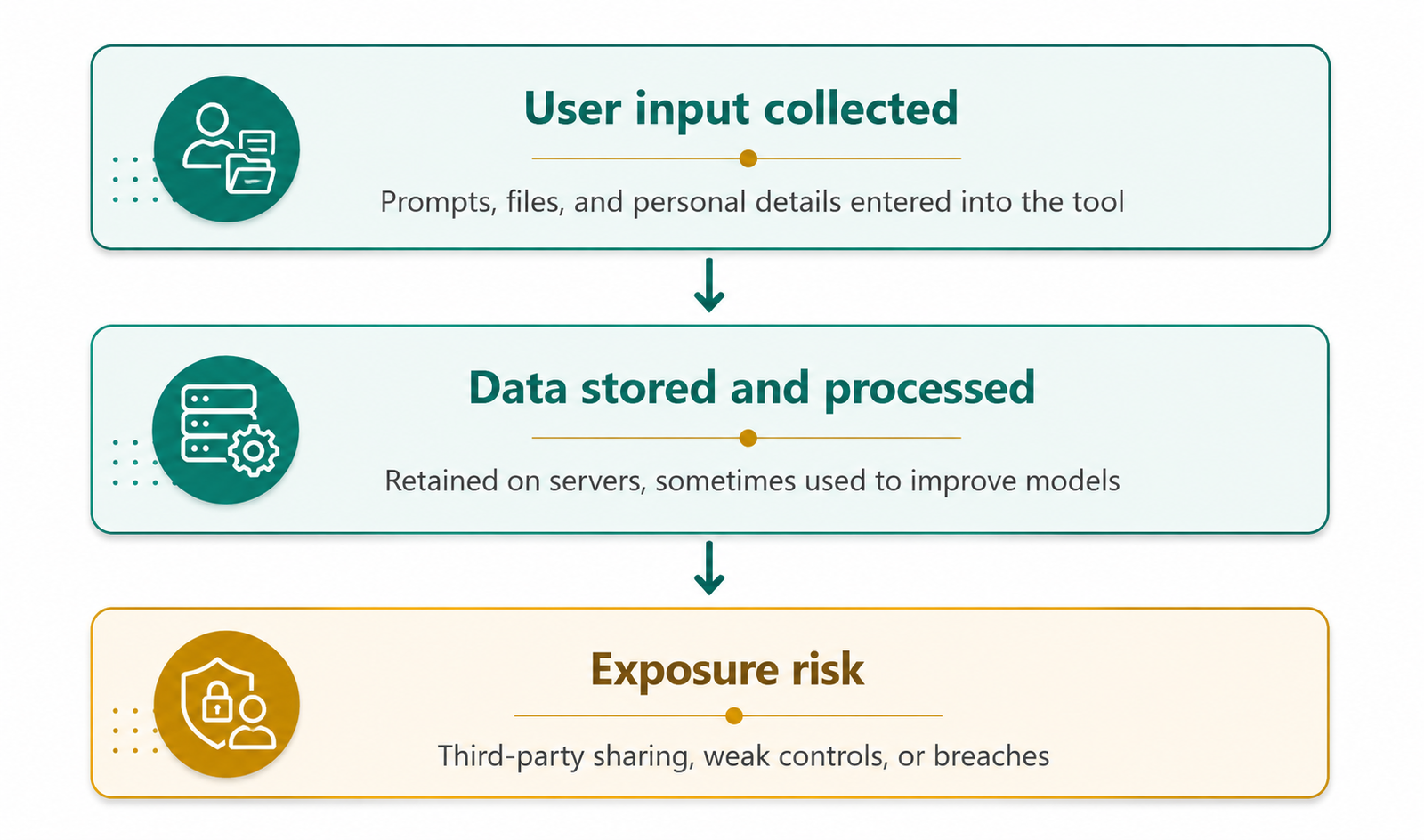
While all AI vendors have an equivalent of a privacy policy, the actual differences between the providers are much more important than the fact that such a policy exists. After getting beyond the marketing buzzwords, we can see the differences in practice that show how seriously privacy is taken.- Opt-out Training Options: Not all vendors provide an option to opt out of model training by disabling it for a user's data.
- Isolation of Enterprise Data: Enterprise versions often provide a greater guarantee of isolating customer data from model training.
- Encryption Varies: The actual methods of encryption, both at rest and in transit, differ, which determines the potential level of exposure in case of a breach.
- Data Residency Options: Some vendors allow you to pick the location where your data will be processed and stored.
- Certifications: Security certifications from third parties provide some assurances about the security, but they only describe processes, not guarantees.
How to Reduce AI Privacy Risks?
Some simple actions will help you reduce the privacy risk associated with using AI tools.
- Use Business Grade AI Tools: Enterprise-grade AI tools are usually better protected than consumer-grade ones.
- Turn On Privacy Mode/Temporary Mode: Modern AI tools provide the user with an option to use privacy or temporary modes.
- Create AI Tool Usage Guidelines: Having clear guidelines within your company on which AI tools are allowed will minimize the risk of your employees accidentally disclosing private information.
- Do Not Disclose Sensitive Information: You should treat your interaction with an AI tool the same way as you would with any public discussion.
- Evaluate AI Vendor Security Practices: You should review an AI vendor’s security and privacy policies the same way as you do with any other software vendor.
Building a Practical AI Privacy Policy
With such ease of sensitive data becoming a part of the everyday use of AI, the most successful companies will not simply put their trust into their employees’ hands; they will create certain and binding guardrails around the way AI is being used internally.- Classify Data Before Sharing: It’s easier to have defined categories of what could and could not be shared via the prompt.
- Approve Certain Tools: Sanctioned AI tools with known practices regarding the handling of data help avoid the use of uncontrolled personal accounts.
- Redact First: Incentives for stripping names, numbers, and other identifiers from the data before pasting into the prompt reduce risk by default.
- Configure Retention Settings: Adjusting retention settings and opting out of training at the account/organization level helps close one of the most common defaults.
- Train, Do Not Publish: Continuous training proves much more effective than reading through policy documents once and leaving them at that.
Conclusion
There is no doubt that the use of AI technologies makes the processes more convenient and faster. At the same time, the privacy issues associated with it are not yet fully understood by the majority of users and companies that apply AI for various purposes. There are a lot of problems related to the lack of appropriate consent and confidentiality violations; there are cases when security is breached, and the automated decision-making process is not transparent. Fortunately, all these issues are quite manageable because they result from ignorance and lack of control. It is quite possible to use AI for various purposes and protect one's privacy at the same time.
Frequently Asked Questions (FAQs)
1. Do AI tools store the data I type into them?
Many AI tools do store conversations, at least temporarily, and some may use that data to improve or train future models unless the user opts out or uses a privacy-focused mode.
2. Is it safe to share confidential business data with AI chatbots?
Generally, no unless the tool is an approved, enterprise-grade platform with clear data handling agreements. Public, free-tier AI tools should not be used for sensitive or confidential information.
3. Can AI tools be hacked or breached?
Yes. AI platforms that store large volumes of user data are attractive targets for attackers, and breaches have occurred through weak passwords, stolen access tokens, and insecure third-party integrations.
4. What laws regulate AI and data privacy?
Laws such as the GDPR, CCPA, and the EU AI Act, along with newer state-level regulations, now apply directly to how AI systems collect, process, and store personal data.
5. How can I use AI tools more safely?
Use business-tier or privacy-focused AI tools, avoid entering sensitive information into public tools, enable privacy or temporary chat modes when available, and follow any AI usage policy your organization provides.

0 Comments