A year and a half later, that fix has rapidly taken over the popularity of traditional API's. By early 2026, MCP's SDKs were seeing over 97 million monthly downloads, and the protocol had been adopted by big companies like OpenAI, Google DeepMind, and Microsoft alongside Anthropic. Numbers like that prove the popularity of MCP, but don't inform what it's actually being used for.
This article walks through the real-world ways teams are putting MCP to work today, across fields of software development, enterprise data, customer operations, payments, content platforms, and infrastructure monitoring.
Table of Contents
What Is MCP?
MCP (Model Context Protocol) is an open standard created by Anthropic that lets AI models like Claude connect to external tools, data sources, and services consistently. Instead of building separate integrations for every app, developers can plug in via one universal protocol.Key Points
- Standardized Connections: One protocol works across many tools/services instead of writing separate custom integrations for each.
- Two-Way Communication: Allows the AI to both retrieve data (read) and take actions (write) like fetching a file or creating a calendar event.
- Client-Server Architecture: Built on a client (the AI app) and server (the external service, e.g., Google Drive) model.
- Open & Extensible: Anyone can build an MCP server for their own app/service, making it community-driven and rapidly growing.
- Security & Permissions: Supports scoped access, servers expose only specific capabilities, and users can approve/deny actions.
Why MCP Matters?
- Solves the Integration Problem: Without MCP, connecting an AI to N different tools means building N custom integrations. MCP converts this into a single standard, reducing development time and maintenance overhead efficiently.
- Interoperability Across AI Apps: Since it's an open standard, an MCP server built once can work with any MCP-compatible AI client, not just one company's product, which avoids vendor lock-in.
- Reduces Duplicate Engineering Effort: Companies no longer need to rebuild the same "connect AI to Slack/Gmail/GitHub" logic repeatedly; the community builds servers once, and everyone reuses them.
- Better User Trust & Control: Standardized permissioning means users know exactly what data or actions an AI can access, making adoption safer for individuals and enterprises.
- Enables Real, Up-to-Date Context: AI models rely on data at training time, but MCP lets them pull live, current data ( files, tickets, databases) instead of relying only on static/outdated training knowledge.
Importance of Use Cases
- Removes the Need for Custom Integrations: Before MCP, every application needed its own custom connector with hardcoded API calls. MCP replaces this with a single, standardized way for AI systems to connect with different tools.
- Makes Existing Tools AI-Ready: MCP does not create new capabilities. Instead, it provides a common way for AI applications to access and use the features that already exist in software and services.
- Speeds Up AI Adoption: Developers no longer have to build a new integration for every AI application. Once a tool supports MCP, it can work with any compatible AI client, saving both time and effort.
- Works Across Different Industries: Whether it is a payment platform, a project management tool, or a cloud infrastructure service, completely different applications can communicate with AI using the same protocol.
- Improves Compatibility: Since every MCP-enabled application follows the same communication standard, AI agents can interact with multiple tools without requiring separate integration logic for each one.
- Builds a Connected AI Ecosystem: The biggest advantage of MCP is that it creates a shared language for AI and software. This makes it easier to build scalable, reliable, and multi-tool AI workflows without reinventing integrations every time.
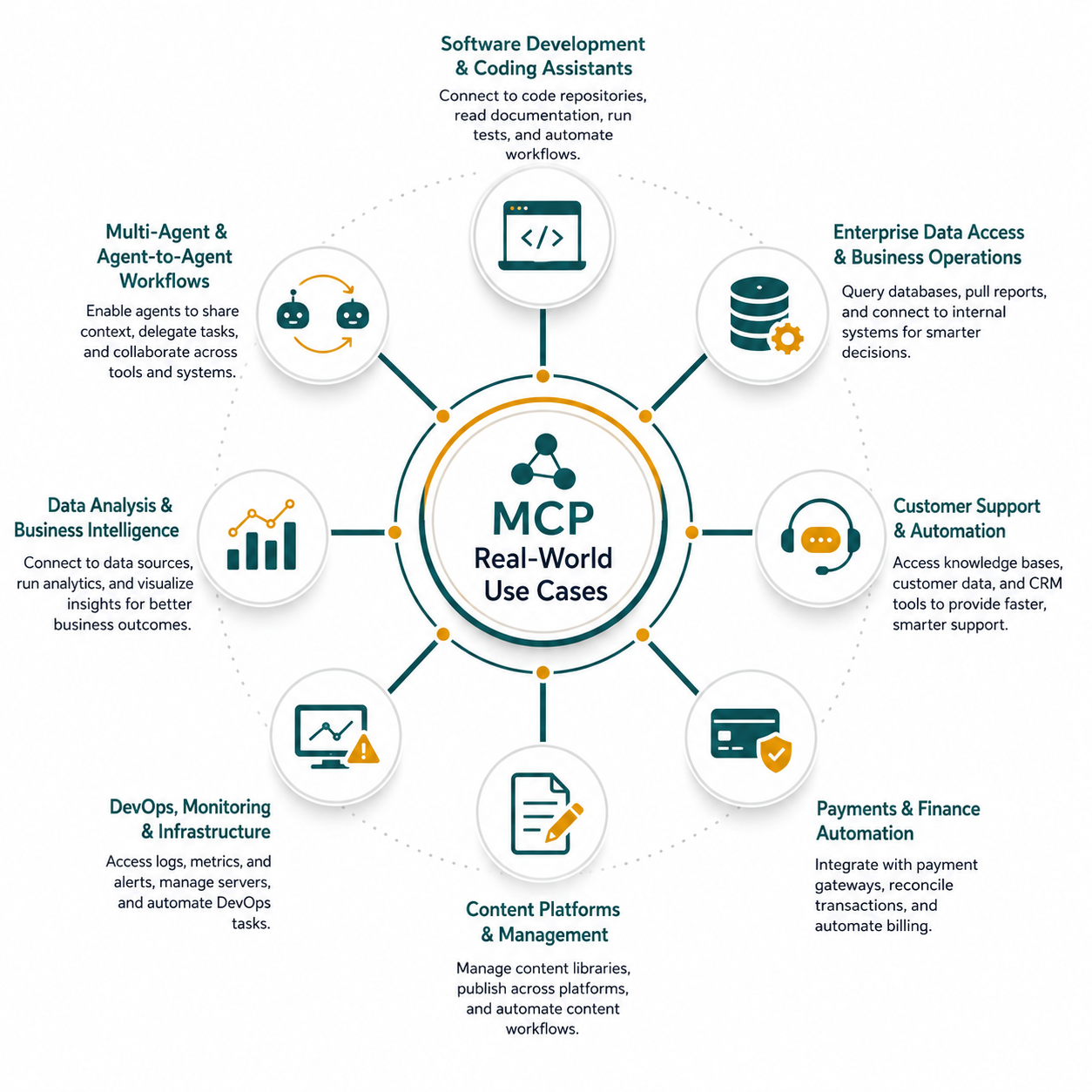
Software Development and Coding Assistants
This is where MCP first took over its implementation, and it remains the biggest use case. Tools like Claude Code, Cursor, Zed, and many more use MCP so that an AI coding assistant can perform functions beyond the code in front of it. Each of the functions is a standard MCP server; the same integrations work whether the developer is using Claude Code, Cursor, or another compatible tool, without anyone rewriting the connector for each platform.
Key Points:
- Increases Efficiency: One MCP integration works across Claude Code, Cursor, Zed, etc., instead of rebuilding a connector for each tool.
- Reduces Overhead: Agents load only relevant tools on demand, cutting context usage by up to ~98.7%.
- Speeds Up Workflow: Live repo/issue state is pulled in the session instead of manually copying and pasting from GitHub.
- Improves Code Accuracy: The AI works from the actual current state of a repo (open PRs, recent commits) instead of outdated context provided by the developer.
- Shortens Debugging Time: Issue trackers and documentation are queried directly, so the AI doesn't need a human to summarize the bug first.
Enterprise Data Access and Business Operations
Enterprises sit on data spread across data warehouses and internal wikis, historically some of the hardest systems to connect AI to safely. MCP is increasingly the layer that mediates that access.
Key Points:
- Reduces Integration Effort: A single governed MCP layer replaces dozens of one-off API integrations per SaaS tool.
- Strengthens Security: Role-based access and audit trails are built into the protocol instead of bolted on per integration.
- Saves Time: Teams update tickets/boards directly from the AI session instead of switching between apps
- Improves Data Governance: Access can be scoped per team or role, reducing the risk of AI agents touching data they shouldn't.
- Increases Consistency: The same MCP connection works across CRMs, ERPs, and internal wikis, so data stays in sync instead of being pulled through separate, mismatched integrations.
Customer Support and Business Automation
Automation platforms have leaned into MCP as a way to expose their existing integration libraries to any AI assistant. Zapier, for instance, now offers an MCP server that connects an AI agent to its network of thousands of app integrations
In customer support specifically, this translates into agents that can look up an order in a support tool, check a customer's subscription status in a billing system, order history, and issue a refund, all triggered from a single request, with the underlying systems talking to the AI assistant through their respective MCP servers.
Key Points:
- Expands Reach: One MCP endpoint stands in for thousands of app integrations instead of custom auth/API work per app
- Increases Efficiency: Multi-step tasks like order lookup, billing check, and refund run in a single request instead of manual cross-tool work.
- Improves Response Time: Faster resolution since the agent takes action, not just retrieves information.
- Increases Accuracy: Responses are grounded in real ticket and knowledge-base data instead of the AI guessing from memory.
- Reduces Agent Workload: Repetitive lookups are automated, freeing human agents for complex or sensitive cases.
Payments and Monetization:
AI is interacting with payment gateways, invoices, subscriptions, and transaction records.
MCP lets an AI agent create invoices, generate payment links, check transaction status, or manage subscriptions directly without a human opening a dashboard. This is also enabling a new pattern where developers paywall their own AI tools, charging for access the same way they'd charge for API usage.
For instance, Stripe is a financial technology company that provides infrastructure for businesses to accept and manage online payments. It's one of the largest private payments companies in the world.
Stripe's MCP server is one of the more widely cited real-world examples because it demonstrates two distinct use cases at once: using MCP to operate a business, and using MCP to charge money for AI-powered tools.
Important Real-World Use-Cases:
- Operating a Business: A support or finance agent connected via MCP can look up a customer's payment history or issue a refund directly, without a human opening the Stripe dashboard.
- Monetizing AI Tools: Combined with Cloudflare's Agent SDK, developers can put a paywall in front of their own MCP servers, so certain tools only respond once a user has paid or holds an active subscription. This is becoming a common way to sell access to AI-powered tools, similar to how APIs are sold today
Key Points:
- Cuts Manual Work: Agents create invoices, payment links, and customers directly instead of using the dashboard manually.
- Simplifies Monetization: Paywalling AI tools becomes plug-and-play with Stripe and Cloudflare instead of custom billing logic per app.
- Reduces Handoffs: Finance and support tools connect directly instead of requiring separate manual steps.
- Speeds Up Reconciliation: Transaction and subscription status can be checked instantly instead of exporting reports manually.
- Lowers Error Risk: Fewer manual data entry steps between systems means fewer chances for mismatched records.
Content Platforms and Management:
AI creating, updating, searching, and publishing content across CMS platforms like WordPress, Notion, or Contentful becomes much easier and smoother using MCP Servers. Webflow's MCP server is a good illustration of how content platforms are exposing themselves to AI agents: it supports content management, auditing, content localization, and site publishing, so a marketing or content team can manage a live website through an AI assistant instead of the Webflow dashboard directly. MCP becomes another entry point into the same underlying platform, alongside the visual editor.
Key Points:
- Speeds Up Publishing: Marketing teams edit, SEO-audit, and publish content via natural language instead of the dashboard UI.
- Streamlines Workflow: Localization and publishing are bundled into one flow instead of being handled as separate manual steps.
- Lowers Technical Barrier: Non-technical users get low-code access to platform features they would otherwise need a developer for.
- Increases Platform Flexibility: The same MCP-based workflow works across WordPress, Notion, or Contentful without separate integrations.
- Improves Content Consistency: Searching and updating existing content directly reduces duplicate or conflicting entries across a CMS.
DevOps, Monitoring, and Infrastructure:
DevOps and infrastructure tools have also adopted MCP so that AI coding agents can act on production issues, not just write code. Cloudflare has gone a step further by exposing its own infrastructure, namely Workers, KV storage, R2 object storage, D1 databases, and DNS through an MCP server, so a developer can modify cloud infrastructure by describing what they need rather than writing deployment scripts by hand.
Key Points:
- Speeds Up Debugging: finding error data and code live in the same session instead of tab-switching between Datadog and the IDE.
- Simplifies Provisioning: Infrastructure is set up by description instead of hand-written deployment scripts.
- Improves Accuracy: Faster, more reliable correlation between code changes and production issues
- Reduces Downtime: Monitoring and deployment checks happen in real time, catching issues before they escalate.
- Cuts Operational Overhead: Routine tasks like resource scaling or health checks can be automated instead of being handled manually.
Emerging Pattern: Multi-Agent and Agent-to-Agent Workflows
MCP in 2026 is headed towards those infrastructure providers that are increasingly designing for stateless MCP servers and automatic tool discovery (sometimes described as "MCP Server Cards"), aimed at supporting agents that discover and coordinate with each other rather than a single assistant talking to a fixed set of tools. This is often discussed alongside the separate Agent-to-Agent (A2A) protocol, which addresses agent-to-agent coordination rather than agent-to-tool access. These two are frequently deployed together in more advanced agentic systems.
Key Points:
- Increases Flexibility: Agents discover tools dynamically instead of relying on a fixed, pre-configured toolset.
- Improves Scalability: Stateless servers support multiple groups of agents instead of one-agent-one-integration setups.
- Reduces Bottlenecks: Agent-to-agent coordination removes the need for a single central orchestrator.
- Speeds Up Complex Tasks: Multiple agents can work on different parts of a problem simultaneously instead of one agent handling everything sequentially.
- Improves Reliability: Shared context between agents reduces duplicated or conflicting work across a workflow.
Data Analysis and Business Intelligence
Analysts have historically had to move data out of a database, into a notebook or BI tool, before an AI model could reason over it. MCP servers built for databases like Postgres and SQLite eliminate that step: an AI assistant can query structured data directly, in plain language, and return an answer without a human writing SQL by hand first. This "natural language data access" pattern is one of the more commonly cited enterprise use cases, since it doesn't require restructuring the underlying data warehouse but requires exposing it only through an MCP server with appropriate read permissions. AI can now query databases, generate reports, create dashboards, and analyze business metrics without facing the "N X M" problem of API's
Key Points:
- Removes Technical Barriers: Plain-language queries replace manual SQL writing.
- Saves Setup Time: No need to export data into notebooks or BI tools first; queries happen in place.
- Improves Accuracy: Schema browsing lets the AI see real table structures instead of assuming them.
- Speeds Up Reporting: Dashboards and summaries can be generated on demand instead of being built each time manually.
- Increases Accessibility: Non-technical stakeholders can get answers from data directly, without waiting on an analyst.
Conclusion
From coding assistants that can read a live codebase, to support agents that can issue a refund, to marketing teams publishing directly, MCP's real-world use cases share a common shape: an AI assistant taking a genuine, authorized action inside a system it previously could only be told about secondhand. As more platforms adopt MCP as a default part of their product, its use cases will likely keep expanding well beyond where it started.
Frequently Asked Questions
1. What industries benefit most from MCP right now?
Software development and enterprise data access are the most mature use cases today, but customer support, payments, content management, DevOps, and data analytics are all seeing fast adoption as more platforms release their own MCP servers.
2. Can one AI agent handle multiple use cases at once, like support and payments together?
Yes, since MCP servers are modular, a single AI agent can connect to several at once (e.g., a support ticket tool and a payments tool), letting it complete multi-step tasks like verifying a customer's billing status before issuing a refund.
3. Is MCP only useful for large enterprises?
No. While enterprises use it for governed, large-scale data access, smaller teams and individual developers use the same protocol for simpler tasks like connecting a coding assistant to a GitHub repo or automating a CMS workflow.
4. Do I need to build a custom MCP server for every use case?
Not usually. Many popular platforms like Stripe, GitHub, Slack, Zapier, Sentry, Cloudflare already offer pre-built MCP servers, so most real-world use cases can be set up by connecting existing servers rather than building one from scratch.
5. What's the biggest limitation across these use case scenarios?
Security and governance are still catching up, connecting an AI agent to sensitive systems (databases, payment tools, internal data) requires careful permission scoping, since a poorly secured MCP server can expose more data or actions than intended.

0 Comments