The student writes a blank file, inputs the prompt into the AI software, and in a few seconds, produces a paragraph that is better written than anything they could have done by themselves. None of it seems unethical; it simply seems helpful. However, where the fine line between "helpful" and "someone did my thinking for me" lies is one of the grey areas in education right now, and most of the students do not know where it is exactly, and work with it without clear terms. The current article is about responsible use of AI technology in academic writing, the reasons why this matter has become so topical so quickly, and how students can work with it without destroying the learning process.
Table of Contents
Essentially, responsible use of AI is simply using the technology in such a way as to promote learning and honest authorship and not to replace either. The concept itself breaks down into a few separate facets, which, understood independently, make it easier to evaluate the responsible use of the technology in any particular application of it, rather than looking at "using AI in school" as a uniform thing.
- Authorship Authenticity: Do the concepts, arguments, and vocabulary present in the assignment belong to the student submitting the assignment?
- Disclosure Accuracy: Has the use of the AI technology been honestly disclosed, or is it left up to the instructor’s best guess?
- Retention Practice: Has the skill required for the assignment been learned through the process of completing the assignment, or was it farmed out?
- Verification Responsibility: Does the student verify the information provided by the AI?
- Equity Access: Has the use of the technology created an imbalance between those with access/skill and those without access/skill?
Why This Has Become an Urgent Issue?
AI writing and reasoning tools were not a consideration for students a few years ago, and the rapidity with which they have become mainstream is the root cause of the current policy challenges. What was once an occasional plagiarism offense is now an everyday judgment call for many instructors.
- Sudden Emergence: Generative AI tools have gone from being unknown to most students to being omnipresent among students within just a few academic terms.
- Fuzzy Task Design: Many assignments did not take into account the possibility that an AI could perform many of the tasks that a student is asked to do.
- Response Lags: Academic integrity policies are still being written for the first time in many institutions, as these tools did not exist several years ago.
- Mutual Escalation: Detection software and AI writing tools are locked in an arms race, with each quickly countering the other.
- Increased Prevalence: Reports of academic integrity violations using AI tools are rising rapidly at many institutions that track such data.
The Main Risks of Unregulated AI Use in Coursework
When considering the risks posed by these tools, they fall under several broad categories. Taken together, these risks are far less intimidating when considered individually, and seeing them in this format can help determine what risks apply to what you are doing.
1. Academic Integrity Erosion
- Plagiarism of AI-generated Content: Work generated by an AI is presented as the student’s own work, but is instead created by an external entity.
- Contract Cheating Hybridization: Many AI tools fulfill the same role as contract cheating sites, but with far greater accessibility and affordability.
- Synthetic Citations: Several AI writing assistants come up with made-up citations and represent them as sources.
- Fuzzy Collaboration Boundaries: When a team works on an assignment with the help of an AI writing assistant, the boundary between individual and team effort can get blurred.
- Uneven Policy Implementation: Teachers within the same educational institute can apply the policy related to AI use quite differently.
2. Learning and Skill Development Losses
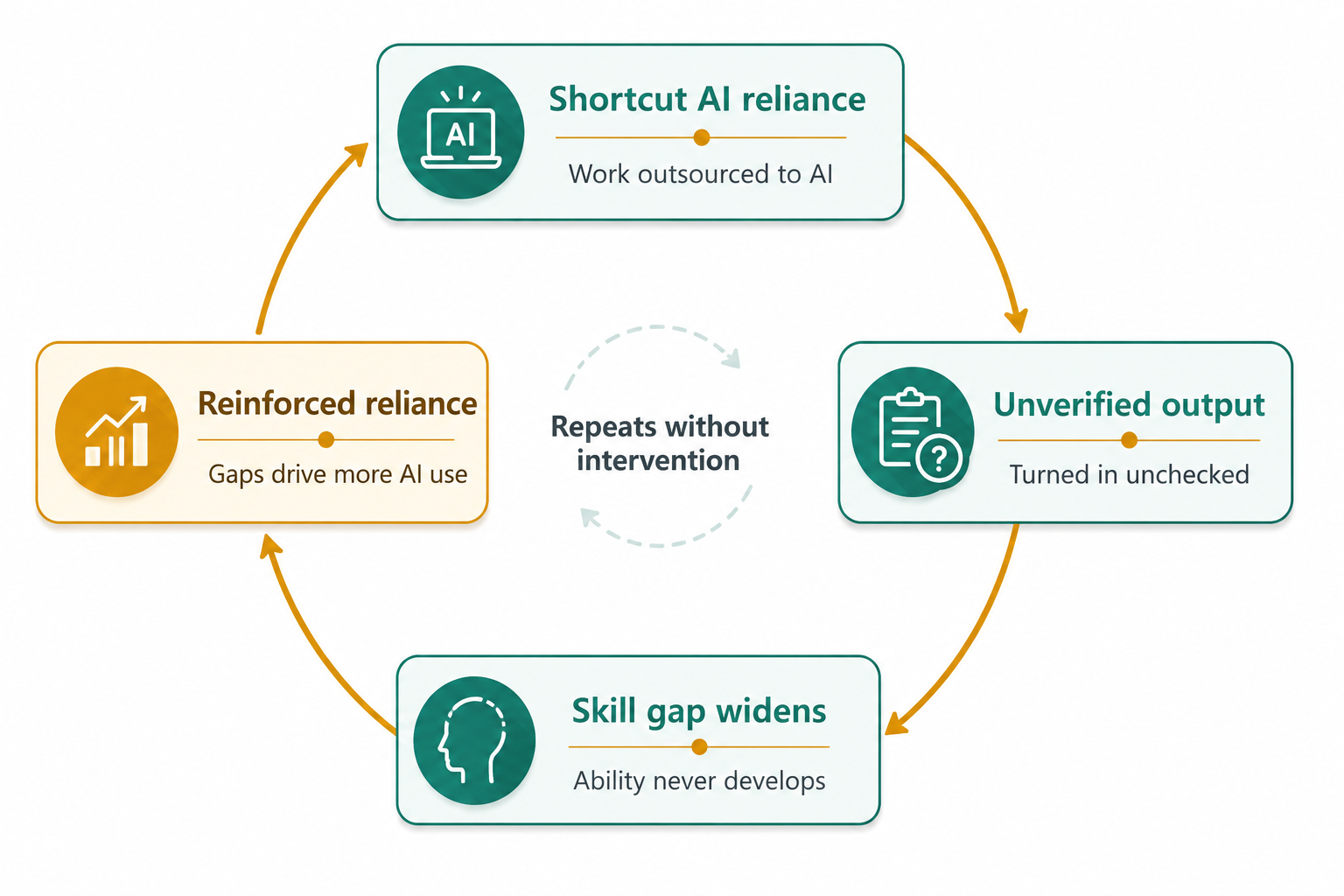
- Skill Bypass: The ability to use an AI tool to draft a paper can negate the opportunity to develop one’s own writing skills.
- Analytical Substitution: The analytical thinking skills of the student can be bypassed when the work is performed by an AI tool.
- Comprehension Shortcuts: Submitting a polished paper generated by an AI tool may prevent the opportunity for an instructor to assess the student’s mastery of the subject.
- Feedback Distortion: An instructor’s ability to provide feedback to a student can be hindered when the submitted work does not reflect the student’s true abilities.
- Skill Debt Carryover: When students use AI tools to bypass learning opportunities, they can find their lack of skills in the subject, affecting their ability to learn in later courses.
3. Accuracy and Reliability Issues
- Confident Hallucination: Many AI tools can generate information with absolute confidence, even when the information is fabricated.
- Outdated Information: Many tools use outdated data, and some can confidently generate information that is incorrect.
- Fabricated Statistics: The use of an AI tool can introduce fabricated statistics into a student’s work.
- Source Misidentification: The AI system may produce content that is a direct copy of content from some published sources, but which is credited to some other sources.
- Continued Errors: If there is any error committed during the writing process, it persists even after the editing process.
4. Equity and Accessibility Disparities
- Access Inequity: Students who can afford higher-end tools have access to features that other students cannot.
- Skill Disparity: The use of AI tools can widen the achievement gap between students who already write well and students who need the practice.
- Digital Fluency Disparity: Students who enter college with less digital fluency than others can be placed at a disadvantage when using AI tools.
- Guidance Inconsistency among Institutions: The guidance regarding the use of AI tools can vary immensely for students from diverse institutions.
- Disparity in Language Proficiency: The use of AI tools can help overcome the language proficiency gap among non-native English speakers.
5. Exposure to Data Collection and Privacy Risks
- Draft Content Exposure: Students who submit a rough draft to an AI tool to be edited may find that the content is used in other ways later.
- Personal Information Exposure: Student coursework involving personal information may be processed by an AI tool, where it can be accessed by third parties.
- Storage Disclosure: Students who use an AI tool do not typically consider how long their content is stored on a server.
- Research Exposure: Faculty research that is submitted to an AI tool for processing faces many of the same risks as student coursework.
- Unreviewed Third-party Exposure: Many AI tools that students use on a casual basis have not been reviewed by the university for how they handle data.
Why Students Use AI Tools Anyway?
When a school’s response to academic integrity issues is to restrict access, the behavior itself is unlikely to disappear entirely. When attempting to understand and combat this behavior, it is fundamental to recognize why students might keep using these tools anyway.
- Time Constraints: Time constraints faced by students could make them use an AI tool in order to save themselves from a long process.
- Policy Ambiguity: Policy ambiguity could make students unaware of what their teacher thinks of the right and wrong use of an AI tool.
- Normalcy Bias: Students can think that everybody is using an AI tool, and they cannot be punished for that.
- Competence Bias: Some students may have low confidence in their abilities and use an AI tool to assist them.
- Risk Discounting: When students perceive the risk of engaging in a behavior to be low, they are more likely to engage in it.
Legal and institutional exposure beyond the classroom
Even when a particular case of misconduct does not go through a formal review process, it can create obligations for both the student and the institution far beyond the initial paper.
- Accreditation Implications: Some accreditation agencies are starting to ask institutions about their policies regarding the use of AI tools.
- Credential Devaluation: If a degree has been tainted by the use of AI tools, it can decrease the value of the degree for all graduates.
- Publication Requirements: Journals are starting to require that papers using AI tools make that fact publicly available.
- Intellectual Property Risks: The intellectual property laws surrounding works created with AI tools are still being decided.
- Due Process Risks: Disputes around the use of AI tools in coursework can arise when evidence is inconclusive.
How Institutions Are Actually Responding?
Every institution has had to update its policy on AI use in coursework at some point, and the real differences between policies can be seen in the fine print. When looking at policies, it is important to look further than the surface-level statements that most institutions use.
- Permission Tiers: Many institutions are starting to adopt policies that distinguish between different levels of AI use on an assignment.
- Detection Tool Dependence: Some institutions place a lot of emphasis on detection software when weighing an academic integrity violation using an AI tool.
- Disclosure Mandates: Many institutions are mandating that students disclose any use of an AI tool.
- Faculty Preparedness: Many faculty members are expected to enforce the AI policy without proper training.
- Assessment Modifications: Many institutions are shifting towards alternative methods of assessment to reduce the role that AI tools play in academic integrity violations.
Common Student Mistakes when Using AI Tools
Some common mistakes when using AI tools can be seen as the root cause of many of the negative consequences that they bring. By understanding these mistakes beforehand, it is possible to avoid them.
- Copy-Pasting Submission: Submitting text generated by an AI tool without any additional editing or human input.
- Disclosure Omission: Failing to disclose the use of an AI tool when the policy explicitly requires it.
- Citation Acceptance: Accepting the citations generated by an AI tool without verifying that they are real.
- Intention Disregard: Using an AI tool when an assignment is designed to teach a skill that the tool bypasses.
- Detection Certainty: Assuming that a detection result means that the work was definitely done with an AI tool when the results are known to be inconsistent.
Development of Responsible Use of AI
In light of the widespread use of such software, the most valuable policy would be one that sets limits on how and what to disclose when employing an AI tool rather than prohibiting its use.
- Definition of Permission: Formulating clear guidelines that outline what is permissible will help avoid violations of academic integrity.
- Disclosure Requirements: Having students disclose what they used an AI tool for can ensure that they understand what they are doing.
- Verification Promotion: Promoting the concept of verifying the work produced by an AI tool can turn a potential liability into a learning experience.
- Assessment Reshaping: Redesigning assessments to be less reliant on writing and other skills that AI tools can assist with can reduce opportunities for misconduct.
- Appropriate Use Exemplification: Encouraging the appropriate use of AI tools by faculty can be an effective way to communicate expectations to students.
Conclusion
AI technologies have not introduced a new dilemma entirely, but rather accelerated the resolution process of an old one, namely, what constitutes work performed by the student. None of this is to suggest that these tools are inappropriate for use in education, as they have the potential to greatly benefit coursework like any other technology. However, they do require the same level of caution and responsibility that any other tool requires to achieve the best results.
Frequently Asked Questions
1. Can one ever use AI in academia for their studies?
Yes, if done within certain limits, such as using AI for purposes of brainstorming, getting feedback, or editing papers, it is generally allowed, while producing the text itself may not be.
2. Can teachers distinguish whether a paper was written with the help of AI?
No, not always; AI detection software cannot guarantee a hundred percent accuracy because of the high probability of errors and false signals.
3. Will disclosing the use of AI save a student from a breach of integrity?
It will if the disclosure reflects the allowed use of AI in that particular assignment or institution.
4. Do all courses/institutions have identical AI policies?
No, policies differ greatly among instructors, departments, and institutions.
5. What is the main danger of unrestricted use of AI for students?
That skill/understanding will not develop due to a lack of actual practice needed for its development.

0 Comments