AI hallucination is when an AI provides misleading information that seems realistic and certain.
It results from the way AI learns through patterns rather than through comprehension of facts.
Hallucinations are unintentional but may be deceitful nonetheless.
Examples of AI hallucinations include fabricated dates, names, statistics, sources, or even events.
This article breaks down everything you need to know about AI hallucinations in the simplest possible language.
By the end, you will understand what it is, why it happens, how to recognize it, and what steps actually help reduce it.
Table of Contents
What Exactly Is AI Hallucination?
To begin with, it will be useful to define the concept in question. Hallucination in AI is not about the machine seeing things that resemble the human experience of hallucinations. This is just a term used by experts to refer to an error made with certainty.
- Wrong Facts: The AI is stating something to be correct even though it is entirely incorrect, without showing any hesitation.
- Fictional Sources: The AI might create imaginary claims or websites with names of nonexistent books or research articles.
- False Confidence: The answer is stated in a certain tone of voice, which makes it even more difficult to detect the error.
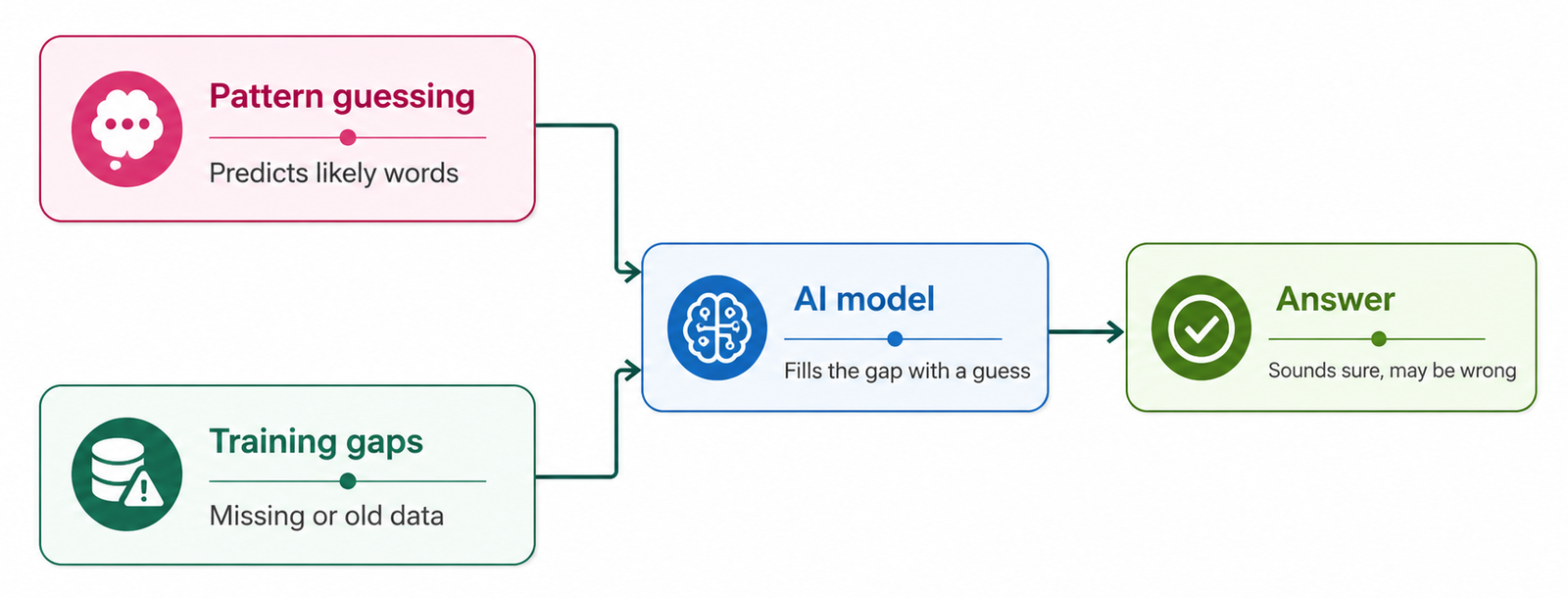
- Lack of Real Knowledge: The AI does not "know" anything as people do; it just predicts the words, which can lead to mistakes.
- Universal: It occurs with nearly all AI language models.
Why Do AI Models Hallucinate?
Knowing the reason makes the phenomenon much less mysterious. AI hallucinations do not emerge randomly or by magic; they occur due to specific technical reasons.
- Pattern Prediction: AI technologies do not search for real facts at all times but rather try to predict what should come next.
- Training Gaps: If AI models were not trained using accurate information on particular topics, they might make assumptions, filling the gaps with plausible information.
- Outdated Information: The training information used to build AI models stops somewhere in the past, and thus it might lack knowledge of more recent facts.
- Ambiguous Questions: Confused or vague user queries might prompt AI to make assumptions instead of asking more detailed questions.
- Pressure to Provide an Answer: Most AI models are expected to provide an answer even if they are unsure about it.
Types of AI Hallucinations You Should Know
Not all hallucinations take the same form. By understanding what each is, it becomes much easier to recognize hallucinations when working with AI.
- Factual Hallucination: These include any factual errors, such as an incorrect date, name, or number.
- Fabricated References: These include fake citations, such as fabricated papers, made-up authors, or non-existent links.
- Logical Inconsistency: This is where the AI contradicts itself in its answer by getting its cause and effect or timeline mixed up.
- Contextual Mismatch: Here, the AI combines information from two entirely different people or subjects to create a false narrative.
- Overconfident Answers: This occurs when the AI answers a question that it simply cannot know.
Real-World Examples of AI Hallucination
Examples make it far simpler to understand for a person who is unfamiliar with AI.
- Legal Misinterpretations: Lawyers have used AI-generated documents as evidence in court that refer to legal precedents that are made up.
- Made-up Book Reviews: There have been instances of AI programs that have summarized books (even with chapter pages) for non-existent books.
- Medical Misinformation: In some instances, AI chatbots have given information about medications or dosages that were inaccurate and potentially dangerous.
- Invented History: AI has talked about historic incidents in detail (with dates and people involved) that have never occurred before.
- Incorrect Product Descriptions: Shopping assistants have provided descriptions of products that were entirely incorrect for the actual product in question.
How to Spot an AI Hallucination?
As AI tends to be confident regardless of its incorrectness, being able to identify potential red flags is probably the best skill for beginners to develop.- Too Detailed Information: A very detailed piece of information without an evident source may be considered a red flag.
- Unverifiable Information: An unverifiable fact is a fact that can never be found on the Internet in any other source whatsoever.
- Links and References: Every link, reference, or citation provided by the AI should be checked as a matter of course.
- Contradictory Answers: If one asks the same question twice and receives two different answers, there is a high possibility of hallucinations.
- Suspiciously Confident Tone: Being suspiciously confident about a niche topic or some other obscure subject may be a sign of hallucinations.
Proven Ways to Reduce AI Hallucinations
This is the most critical area for any individual designing, developing, or refining an AI system. This is because the above-listed practices have become quite common in AI firms.
- Improving Training Data: The use of accurate and diverse data for the training process makes it less likely that inaccurate patterns will arise.
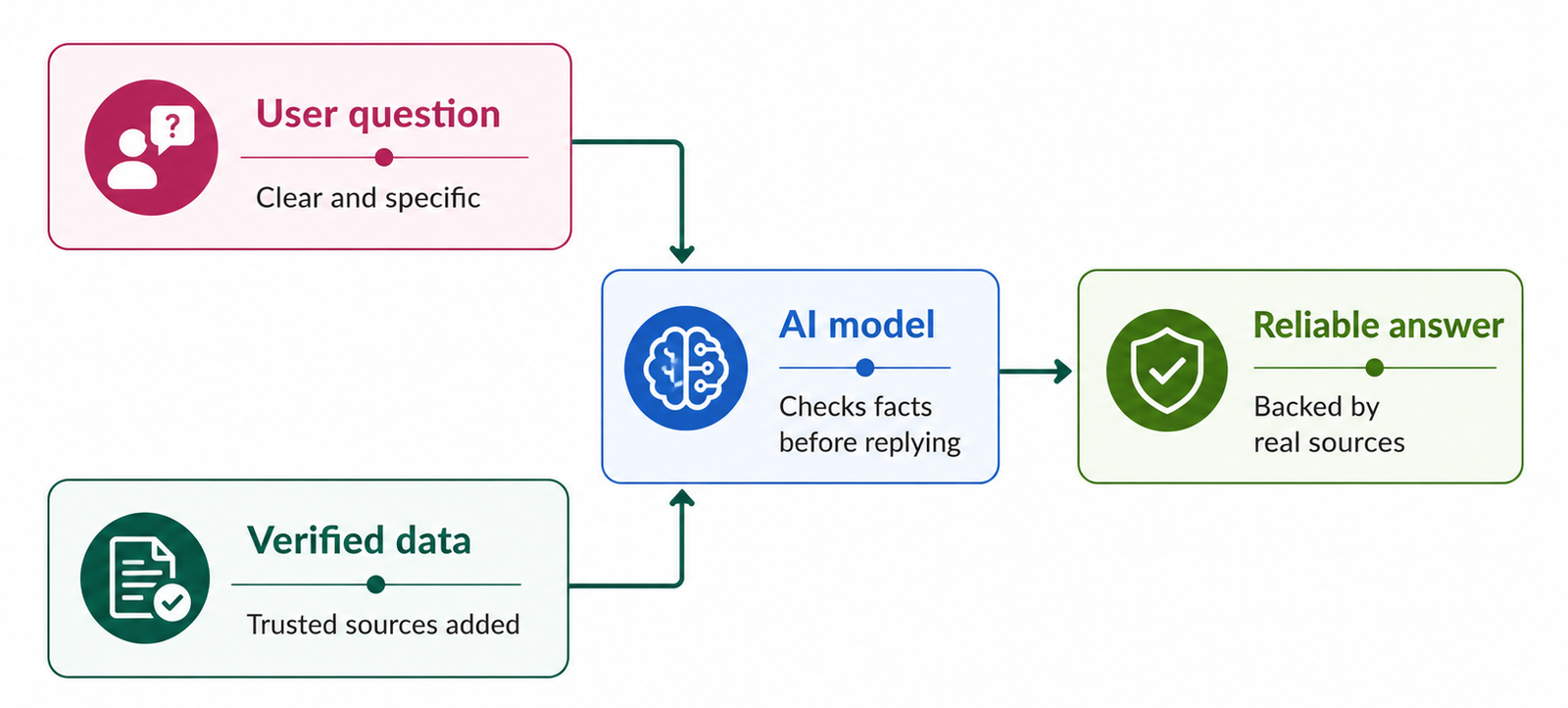
- Retrieval Augmentation: Linking the AI system to actual documentation or databases for reference before giving its output makes the answers more factual.
- Fact-Check Layers: Using additional AI systems to verify the outputs before being released to users.
- Confidence Scores: Making the AI system capable of giving uncertain responses rather than giving an incorrect response.
- Human Feedback: Checking the work of the AI system manually by humans and then using that information for retraining the model.
Best Practices for Everyday Users
Elimination of hallucinations is not the sole responsibility of AI firms. Users, even novices, can adopt simple strategies as well.
- Cross-Check Facts: Verify any significant facts and figures such as numbers, names, and dates by consulting a secondary reliable source.
- Ask Further Questions: Asking the AI for clarification regarding its reasoning helps determine the reliability of the response.
- Avoid Unclear Prompts: Formulating clear prompts makes it unlikely that the AI will fill in blanks with assumptions.
- Employ Reliable AI Tools: Make use of AI tools that have a reputation for sourcing their answers from credible information.
- Be Critical: Always treat the AI’s answers critically because the output is not always factual and reliable.
The Future of Hallucination-Free AI
Even though hallucinations will never go away entirely, the technology itself is advancing at a rapid pace, and it might be useful to know what is coming.
- Smarter Verification: Future systems are anticipated to verify claims against real-time and verified databases automatically.
- Transparent Information Source: Increasing numbers of tools are able to demonstrate clearly where the data used in an answer came from.
- Increased Honesty: The new models are programmed to say that they do not know the information required instead of guessing.
- Industry Standards: Organizations and scientists are now creating joint benchmarks for evaluating AI efficiency and accuracy.
- User Education: With increased awareness, more users learn how to use AI ethically along with technical advancements.
Conclusion
The phenomenon of AI hallucinations is when an AI produces a very confident yet incorrect output.
This occurs because AI makes predictions based on patterns rather than actually having knowledge about the facts.
Examples of hallucinations may be incorrect facts stated by an AI, false sources cited by an AI, and other fictional things created by an AI. Developers work on developing AI to detect errors and uncertainties.
Frequently Asked Questions
1. Is AI hallucination the same as a technical error or bug?
Not exactly. A bug usually causes a system to crash or malfunction, while hallucination is the AI working normally but producing incorrect information confidently.
2. Can AI hallucination be completely eliminated?
Currently, it cannot be removed entirely, but ongoing improvements in training methods and fact-checking systems continue to reduce how often it happens.
3. Why does AI sound so confident even when it's wrong?
AI is trained to generate smooth, natural-sounding language, which can make even incorrect answers appear polished and certain.
4. Does hallucination happen more with certain topics?
Yes, it tends to happen more with very specific, technical, or recent topics where the AI has limited or outdated training information.
5. As a beginner, what's the simplest way to protect myself from AI hallucination?
Always double-check important facts using a trusted second source, especially before making decisions based on health, legal, or financial information.

0 Comments