In today's AI-driven world, the sizes of large language models now reach hundreds of billions of parameters, and it has become prohibitively costly to fine-tune them in the old-fashioned way by optimizing all the weights. And LoRA, which stands for Low-Rank Adaptation, appeared as an approach designed precisely to address such issues, allowing one to modify a large pre-trained model without having to optimize any of its initial parameters. Rather than training the entire model from scratch, LoRA involves adding specialized modules that can acquire new knowledge without modifying the base model at all. LoRA saves significant computing resources and enables customization of large language models even for teams with no access to enterprise-level GPUs. In this article, I'll introduce the notion of LoRA and discuss its implementation in detail.
Table of Contents
What Is LoRA?
LoRA stands for Low-Rank Adaptation. It is a method that tunes a pre-trained model to perform on some other task by training a few additional parameters. While in most tuning methods the whole model is tuned, in LoRA the model is tuned by adding only a few additional adapter matrices to the original model. This way, the majority of pre-trained parameters of the model are not changed. As a result, the tuned model is small and easy to store and reuse.
- Parameter-Efficient By Nature: only a small number of parameters are tuned, less than 1% of the whole model.
- Original Weights are Frozen: All knowledge from the base model is retained during training.
- Adapter Matrices are Added: Small matrices are added to the layers of the model.
- Requires Much Less Memory: The memory required for training is much lower than in the case of training a whole model.
- Output is Much Smaller in Size: Usually, it takes only a few megabytes instead of gigabytes of the whole model.
What Does "Low-Rank" Actually Mean?
For the concept of LoRA, one should first have an understanding of the basic idea of matrix rank. A high-rank matrix is a matrix containing a great deal of independent information, whereas a low-rank matrix represents a matrix containing compressed information. To illustrate this further, one can think about an image in which the uncompressed version contains all the pixels, while the compressed image in the form of a JPEG will contain the important visual information without the redundant data. LoRA adopts this concept of information compression, but does it with weight updates, where it retains only what is necessary to reconstruct the relevant information.
- High Rank Refers to More Independent Information: Full weight updates contain an abundance of independent information.
- Low Rank Implies Compressed Information: In most cases, the updates are highly correlated and thus can be described more efficiently.
- Compressed Information is Not Equal to Loss of Vital Information: Like the JPEG, the compressed matrix retains the vital information.
- Done Using Two Smaller Matrices: The big matrix is decomposed into the multiplication of two smaller matrices.
- "rank" is a Tunable Hyperparameter: A small number, often 4, 8, or 16, controls how much compressed capacity the adapter has.
Why Was LoRA Created?
Training large models using full fine-tuning involves billions of parameters that require extensive memory, training time, and disk space for each fully fine-tuned instance of the model. In one case, fine-tuning a 7-billion-parameter model can demand several gigabytes of GPU memory alone for training; when there are many different specialized models required, the costs become prohibitive. This issue led to the introduction of the LoRA technique by researchers at Microsoft precisely to overcome this problem, because it was observed that the adaptations needed for a specific task could be encoded in a much smaller space.
The need for creation of LoRA include
- Fine-tuning Needs Exhaustive Resources: Each parameter of a large model needs to be trained in a cluster of high-memory GPUs.
- Disk Space Gets Quickly Consumed: A fully fine-tuned model will consume as much disk space as the original base model.
- Several Use Cases Lead to Many Versions: Multiple models need to be maintained, multiplying the costs of full fine-tuning.
- Low-rank Adaptation is Core Idea: Researchers discovered that the update to the model weights for a specific task is low-dimensional.
- Efficiency Without Major Performance Loss: LoRA was designed to match full fine-tuning's results while using a fraction of the resources.
A Simple Analogy: Editing a Book Instead of Rewriting It
Suppose you have a 2,000-page book, and you wish to make an edition of this book suitable for engineering students, but without altering the original. In this case, traditional tuning implies that you rewrite all 2,000 pages again, even those that do not require any changes. LoRA is like adding sticky notes on the necessary pages, thus keeping the original book untouched, while any reading of this book will include both the original text and the additions to it, just like LoRA does with a neural network.
- Pretrained Model Weights Are Frozen: LoRA never updates the original parameters of a neural network.
- Lightweight Adapter Matrices Are Trained: Instead of tuning billions of parameters, LoRA trains only two small low-rank matrices corresponding to task-specific changes.
- Prediction Includes Base Model Weights and LoRA Updates: During inference, LoRA uses original weights together with new low-rank adapter matrices for output generation.
- Adapters are Modular and Removable: As the base model is not altered in any way, LoRA adapters can be added, removed, or substituted at any time.
- Single Base Model Can Support Multiple Tasks: Various LoRA adapters could be trained for programming, customer services, healthcare, language translation, etc., enabling the reuse of the existing pre-trained model.
How Does LoRA Work?
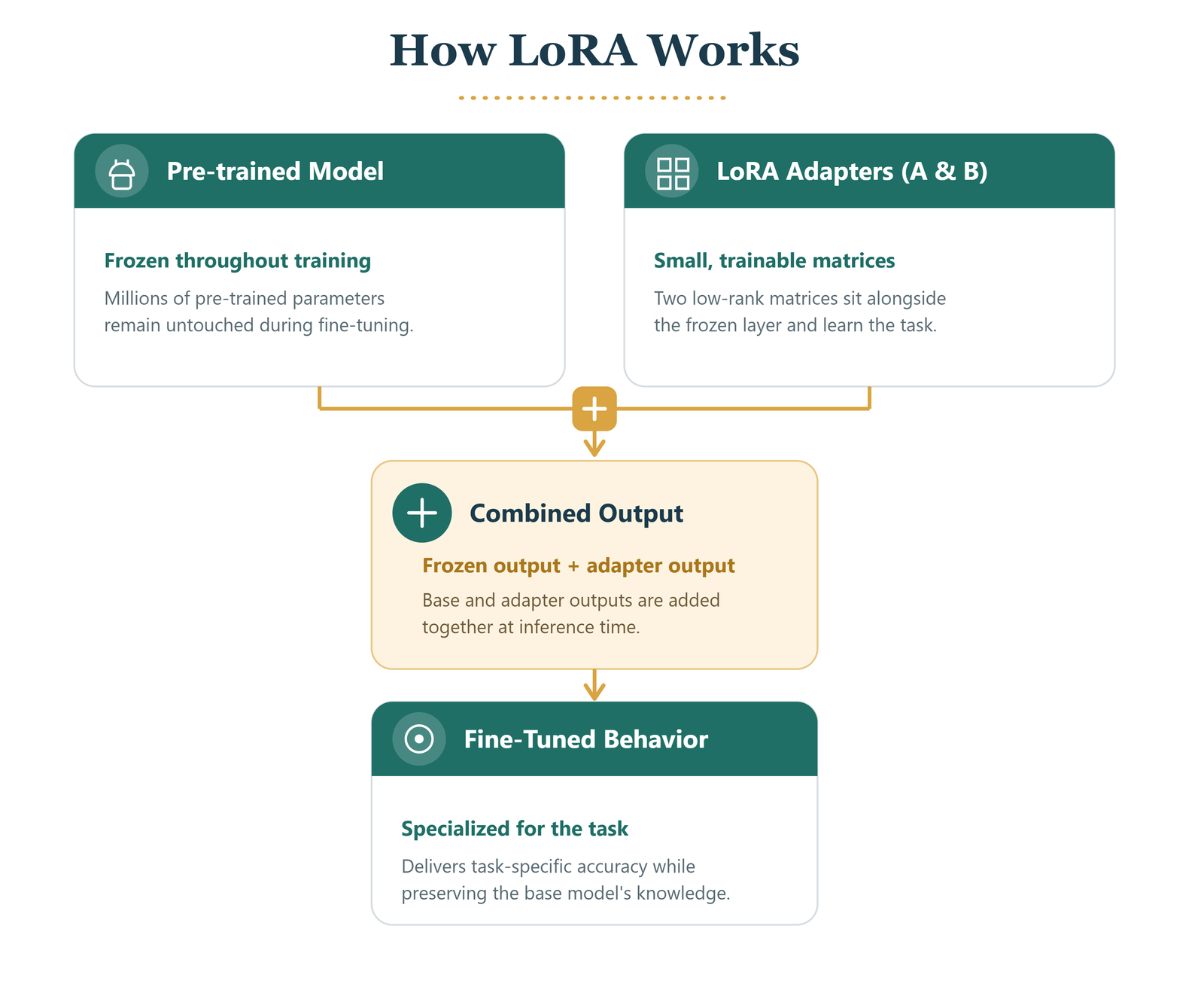
Technically speaking, LoRA keeps the original weight matrix of a layer frozen but introduces two additional, small and trainable matrices, the multiplication of which approximates the matrix updates that the original matrix would have had. Since the two matrices introduced are much smaller than the original matrix, the number of trainable parameters is drastically reduced while still being able to learn some task-specific behavior. In inference mode, the output from the frozen layer and the small matrices are summed up, thus combining the knowledge of the base model and the newly learned one. This is the trick that gives the approach its name- "low-rank" means the low-dimensional space that the adapter matrices occupy.
- Freezes Base Weight Matrix: The original pretrained weights are frozen and not trained at all.
- Introduces Two Small Matrices: Two low-rank matrices are introduced along with the frozen ones to learn something new.
- Multiply Matrices to Approximate Updates: The multiplication of those two matrices approximates the full weight matrix update.
- Combines Outputs At Inference: The frozen layer output and the adapter output are summed to give the final result.
- Trains Only Adapters: The backpropagation updates only the small matrices.
The Mathematics Behind LoRA
Suppose a neural network layer has a weight matrix: W
Traditional Fine-tuning Learns:W' = W + ΔW
where:
- W = original weights
- ΔW = learned updates
LoRA replaces this with:
ΔW = B × A
where:
- A has dimensions: r × d
- B has dimensions: k × r
Here,
- d = input dimension
- k = output dimension
- r = rank (very small)
Usually,
r = 4, r = 8, r = 16. Instead of thousands. Since r is tiny, the number of trainable parameters becomes dramatically smaller.
Step-by-Step Workflow of LoRA Training
- Step 1: Load a Pretrained Model: Choose a model like Llama, Gemma, or GPT-style models. The pretrained weights remain frozen.
- Step 2: Insert LoRA Adapters: Small trainable matrices are attached to selected layers. No original weights are modified.
- Step 3: Freeze the Base Model: All billions of parameters stop learning. Only adapter weights remain trainable.
- Step 4: Train on Your Dataset: For instance, Customer support conversations, Medical records, Legal documents, and programming questions. Only LoRA parameters are updated.
- Step 5: Save Adapter Weights: Instead of saving the entire model, only a few megabytes of adapter weights are saved.
- Step 6: Load base model+LoRA together: After training, the LoRA adapters are combined with the pretrained model. The original model contributes its existing knowledge, whereas the adapters add specific behavior for the task at hand.
Which Layers Does LoRA Modify?
LoRA is not uniformly distributed in the whole model; it is rather selectively used in particular layers with significant contributions to performance. With the use of transformer models, those layers can be chosen as layers with the attention mechanism, which plays an important part in the way a model processes input data. Choosing fewer layers helps to maintain the number of parameters in a small range while providing significant task-specific adaptation.
- Layers With Query Projections: Adapted because of their major contribution to the way the model pays attention to input data.
- Layers With Value Projections: Used along with layers with query projections due to the performance boost in combination with a low parameter cost.
- Layers With Key Projections: Selected for the purpose of adding some capacity when necessary.
- Layers With Output Projections: Used in cases of larger-scale adaptation.
- Layers With Query and Value Projections: Many adaptation frameworks use adaptation of only these two layers due to the better parameter-to-performance ratio.
LoRA vs Full Fine-Tuning
Understanding how LoRA stacks up against traditional full fine-tuning makes it much easier to decide which approach fits your project's constraints. The table below compares the two methods across the factors that matter most when planning a fine-tuning project.
| Factor | LoRA | Full Fine- Tuning |
|---|---|---|
| Parameters trained | A small fraction, often under 1%, is trained. | All model parameters are trained. |
| GPU memory required | Significantly lower. | Very high, especially for large models. |
| Training time | Faster due to fewer parameters. | Slower, especially at scale. |
| Storage per fine-tuned version | A few megabytes are needed. | Often gigabytes, the same size as the base model. |
| Risk of catastrophic forgetting | Lower, since base weights stay frozen. | Higher, since all weights can shift. |
| Ease of switching tasks | Easy to switch as the swap adapter weighs in and out. | Difficult as it requires loading a full separate model. |
| Performance on complex tasks | Strong, though sometimes slightly below full fine-tuning. | Typically, the highest achievable performance. |
| Accessibility for smaller teams | High accessibility is feasible on consumer-grade GPUs. | Low accessibility, as it usually requires enterprise hardware. |
Key Components of LoRA
Effectively using LoRA entails an understanding of several configurations that impact performance, efficiency, and training stability. These include trade-offs between the capacity of the adapters and the efficiency of the training process. Tuning of these parameters becomes more important compared to the algorithm used.
- Rank (r): This configuration specifies the dimension of the low-rank matrices used, controlling the capacity of the adapters.
- Alpha: This is a scaling coefficient that determines how much effect the changes learned by the adapter have on the output.
- Target modules: Specifies which layers of the architecture to attach LoRA adapters to, such as attention layers.
- Dropout: Provides regularization in the adapter layers to avoid overfitting in small datasets.
- Learning rate: Usually larger than the one used for full fine-tuning due to fewer parameters to update.
Advantages of LoRA
Efficiency gains in LoRA have helped to make it one of the most popular methods of fine-tuning in scenarios where compute resources are limited. Apart from cost savings, such gains also allow new applications that would have been impossible without them. Some of the areas where LoRA shines are listed below:
- Low Hardware Demands: Fine-tuning can be carried out using standard consumer GPUs instead of enterprise-grade clusters.
- Increased Training Speed: Fewer weights make the training process significantly faster than full fine-tuning.
- Small Size: The weights of the adapter are much smaller than those of a fully fine-tuned model.
- Flexibility of Task Adaptation: Several LoRA adapters can be used with the same base model for various tasks.
- Decreased Possibility of Forgetting: Base model weights remain frozen and hence do not forget.
Limitations of LoRA
LoRA is not perfect despite being efficient; therefore, an awareness of LoRA’s limitations can help one understand the actual limitations and avoid having unrealistic expectations at the beginning of any project. The following are some of the limitations of LoRA, which are related to the actual reason LoRA is efficient.
- Marginally Lower Ceiling in Case of Complex Tasks: In some cases, LoRA might be unable to achieve the kind of performance obtained by full fine-tuning when handling very complex tasks.
- Requires Hyperparameter Tuning: If rank and alpha are not well chosen for the task, the results can be negatively affected.
- Task Still Requires a Labeled Dataset: Labeled data will still be required to train LoRA effectively.
- Does Not Allow Modification of Base Knowledge: Since the base model remains unchanged, LoRA does not allow the modification of pre-trained knowledge in the model.
- Adapter Sprawl is a Challenge: One needs to keep track of different adapters for various tasks.
When Should You Use LoRA?
LoRA is most valuable when you need to customize a large model without the budget or infrastructure for full fine-tuning. It's also an excellent fit for teams that need to maintain multiple specialized versions of the same base model efficiently. The scenarios below highlight situations where LoRA tends to be the right choice.
- Limited GPU Resources: Your team doesn't have access to large-scale training infrastructure but still needs a specialized model.
- Multiple Task-specific Versions: You need several adapted versions of the same base model for different use cases or clients.
- Rapid Experimentation: You want to quickly test different fine-tuning configurations without long training cycles.
- Frequent Model Updates: Your use case requires regularly retraining or adjusting the model as requirements evolve.
- Deploying on Constrained Hardware: You need to fine-tune and deploy models in environments with limited memory or compute.
Some Common Real-World Applications of LoRA
The LoRA methodology has become widely used among many real-world AI applications thanks to the ease with which this method can help in customizing models without expensive hardware infrastructure. Due to its efficiency, LoRA has been particularly widespread in open source and community-based AI developments. Let’s consider the use cases of LoRA.
- Chatbots Customization: The adjustment of the general chatbot to a certain brand identity or customer care style.
- Assistants for Certain Domains: Fine-tuning of models for certain industries such as law, medicine, or technology without complete re-training.
- Models of Image Generation: Often used to fine-tune diffusion models on certain artistic styles or topics.
- Model Adaptation for Multilingual Use: Adjustment of base models’ performance for particular languages.
- Quick Prototyping of Research: Researchers can test various ideas for fine-tuning efficiently and cheaply.
Common Misconceptions About LoRA
Since LoRA is quite a technical topic, there are some myths associated with the functioning of this technique that are quite commonly raised and cleared here. They help shape proper expectations concerning the capabilities of LoRA. Some common misconceptions include:
- "LoRA fine-tunes the whole model.": It is not true because the original model is frozen, and only the adapter matrices are fine-tuned.
- "LoRA will never perform as well as full fine-tuning": Not necessarily, for many practical tasks, the results obtained with LoRA are comparable to those for full fine-tuning.
- "LoRA makes the pretrained model irreversible": Not true because the base model remains unchanged, and adapters can be added or removed whenever necessary.
- "LoRA is used only for language models": Not true, LoRA can also be successfully applied to vision, diffusion, and speech models.
- "Highest rank leads to the best results": Not necessarily because a higher rank increases the capacity of the model, but also the number of its parameters.
Optimal Methods for Using LoRA
For optimal results with LoRA, one needs to be strategic in terms of proper setup and experimentation; this cannot be done with a simple application of default parameters. A slight change in the values of rank, target layer or learning rate would significantly impact the quality of the final fine-tuned model. The following best practices are examples of how LoRA should be applied.
- Use a Moderate Rank: First, set a small rank value (like 8 or 16); increase the rank if the model is underperforming.
- Target Appropriate Layers: Adapters should be focused first on attention layers because they have the biggest effect on the task's performance.
- Select Proper Learning Rates: As fewer parameters are being learned, one will need to use much larger learning rates compared to full fine-tuning.
- Perform Validation on Hold-out Dataset: Constant validation should be done to make sure that the model is improving.
- Keep Base and Adapters' Weights Separated: Save adapters separately from the base model.
Conclusion
LoRA has revolutionized the accessibility of fine-tuning large language models by making it possible for organizations to tweak highly capable models without having to incur huge costs of computation and storage. Since the base model is frozen while training only small and low-rank adapter matrices, LoRA retains the benefits of fine-tuning without having to pay the costs of doing so. This method has been especially useful for organizations that want to keep several customized versions of models, conduct experiments quickly, or have limited budget constraints for hardware. While LoRA may not perform as well as full fine-tuning on more complicated tasks, it is one of the most popular methods in AI today.
Frequently Asked Questions
1. Can multiple LoRA adapters be used with the same base model?
Yes. One of LoRA's biggest advantages is its modularity. A single pretrained model can have multiple LoRA adapters, each trained for a different task such as coding, legal analysis, or customer support. You can load or swap adapters as needed without creating multiple copies of the base model.
2. Is LoRA suitable only for text-based AI models?
No. Although LoRA became popular with large language models, it is also widely used in vision transformers, image generation models like Stable Diffusion, speech recognition systems, and other transformer-based architectures where efficient fine-tuning is required.
3. Does LoRA reduce inference speed?
Generally, the impact is minimal. In many deployments, LoRA adapters can even be merged into the base model after training, eliminating additional runtime overhead entirely.
4. What's the difference between LoRA and QLoRA?
QLoRA combines LoRA's low-rank adapters with model quantization, compressing the frozen base model to a lower precision for even greater memory savings.
5. When should I choose LoRA instead of full fine-tuning?
Choose LoRA when you want a cost-effective way to adapt a pretrained model, have limited GPU resources, need multiple task-specific versions, or want faster experimentation without modifying the original model.

0 Comments