Unlike previous models of AI, such as ChatGPT, Claude, and Gemini, contemporary AI models are not only trained to predict the next word in the sentence but also to be helpful, truthful, and aligned with the user's needs. The thing is that alignment does not arise spontaneously in the course of pretraining but is achieved using Reinforcement Learning from Human Feedback (RLHF). Unlike the traditional way of training AI models to replicate the Internet text, RLHF involves teaching an AI model to favor those responses that are rated as positive, harmless, and useful by people. This is what makes an AI model a helpful assistant that can follow users' commands, reject inappropriate requests, and communicate in a truly helpful way. This article explains what RLHF is and how it is done.
Table of Contents
What is RLHF?
RLHF stands for reinforcement learning from human feedback. It is a technique used to fine-tune a language model by incorporating human preferences into the training process, rather than relying solely on a single reward function. Through RLHF, human evaluators judge the outputs of a language model, and the reward model is updated to align with these preferences. This method has become widespread in modern AI training and is used by many large language models to improve performance and alignment with human expectations.
Some notable characteristics of RLHF include:
- Human Preferences are Used to Train Model: Rather than optimizing a model to predict the next word in a sequence simply, RLHF judges outputs against human preferences.
- A Reward Function is Learned: Human judgments of model outputs are used to train a reward model that can generalize to new prompts.
- Uses Pre-Trained Language Models: RLHF typically uses language models that have already been pre-trained on a large corpus of text.
- Focuses on Model Alignment: RLHF aims to make a model’s outputs more desirable to humans.
- Implemented by Many Modern AI Assistants: It has become widespread amongst large language models to improve their performance.
Why Was RLHF Developed?
The first attempts at creating language models, trained simply to predict the next word based on text from the internet, often resulted in fluent but useless, evasive, or even malicious replies. The lack of any intrinsic understanding of what makes an answer appropriate or good meant that the resulting answers were not aligned with human intentions, since there was no other criterion to train the model besides statistical properties of the data. A method was needed to introduce human preferences into training in a scalable manner, instead of manually correcting mistakes or writing instructions.
- Language Models Lacked Judgment: Pretraining couldn't teach the model how to answer properly from a human standpoint.
- Handwritten Rules are Difficult to Generalize: Fixed instructions are unlikely to cover all situations where a model is expected to act.
- Difficult to Define Human Preferences in Absolute Terms: People are better at comparing two examples than at formulating exact rules.
- Needed Some Kind of Feedback Mechanism: A repeatable process of improving the model by using human judgment was necessary.
- Alignment Problem Became Relevant: It was necessary to align models' output with human preferences and intents.
The Three Stages of RLHF
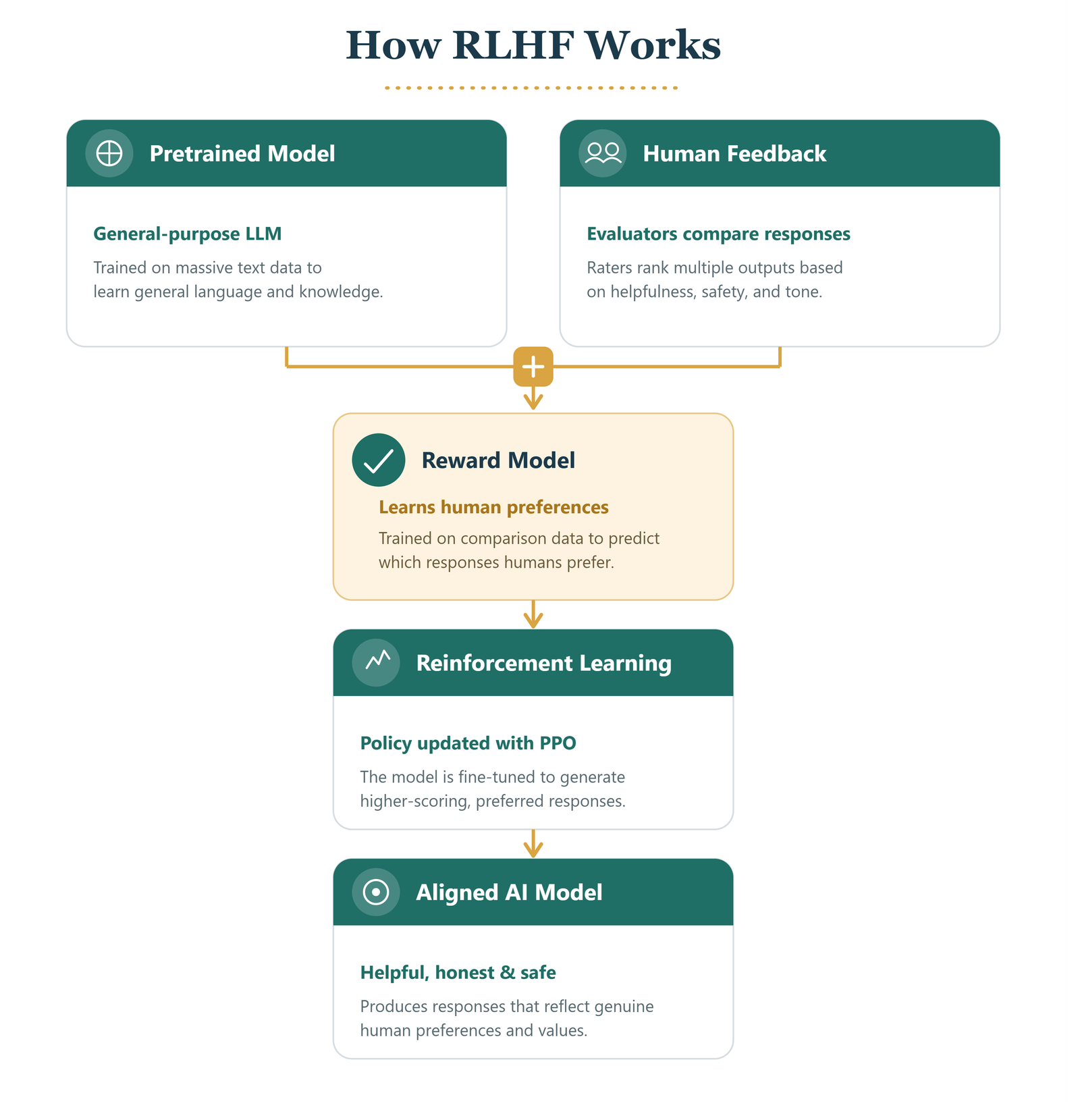
Unlike the training process itself, RLHF is not carried out in one step. On the contrary, RLHF consists of three consecutive steps that help train a model from a general-purpose text predictor to one capable of producing human-preferred responses. The knowledge of these steps is crucial to understanding how exactly human input is converted to output generated by the model.
Given below are the three stages followed by refinement:
- Pretraining: The initial base language model is trained on large amounts of general texts.
- Training of the Reward Model: Human experts evaluate outputs of the model based on their preferences, which helps train another model – the reward model.
- Fine-Tuning of the Model Through Reinforcement Learning: The base language model is again trained through reinforcement learning based on the reward model outputs.
How Does the Reward Model Work?
The reward model is the element of the system that helps convert human preferences into a metric that can be optimized by machine learning algorithms. Instead of evaluating responses individually, the reward model is usually trained using comparison rankings made by human evaluators between the responses in question. In other words, the reward model is trained on a set of ranked responses, learning to predict human preferences, even for unseen prompts. This prediction becomes the optimization target for the next stage of training.
Reward models work on the basis of these parameters:
- Human Comparisons-Based Training: Human evaluators rank several responses to the same prompt.
- Predicts Preferences Rather Than Quality: The reward model learns which patterns of behavior lead to human choices of better responses.
- Gives Out One Reward Score: For every response, the reward model generates one number — score.
- Predicts Preference Even for Unseen Prompts: A good reward model predicts human preferences even for new prompts.
- Optimization Target in the Reinforcement LLearning Stage: Response score becomes the signal that defines behavior updates in the language model.
The Role of Human Feedback
The human feedback provided serves as a key difference between RLHF and its predecessors, as its quality dictates the performance of the resulting model. As opposed to the simple labeling process of the past approaches, where people would simply assign a response a right or a wrong label, in RLHF, people would be asked to compare multiple responses and identify the preferred one. Comparative judgment often yields higher levels of consistency and reliability compared to rating individual responses with an absolute value.
Human feedback becomes an essential step because:
- Comparative Judgment Over Scoring: People choose between pairs of responses as opposed to giving them numerical grades.
- Guided By Explicit Criteria: Human raters often receive clear instructions on what kind of responses they should pick.
- Captures Nuances Language Models Can Miss: Feedback provided might be based on subtle language features such as tone, helpfulness, safety, etc.
- Needs Diversity Among Evaluators: A diverse pool of raters increases the chances of not developing skewed preferences.
- Human Feedback Affects Results Greatly: Poorly trained human feedback can yield a reward model that encourages the wrong behaviors.
Collecting Human Feedback
In order to begin training a model to learn any form of feedback, it is important for an organization to establish a process by which this feedback is collected on a larger scale. This process starts by having a substantial set of prompts that represent the kinds of prompts and tasks that the model will be expected to perform in practice. For each prompt, the model provides a number of different possible responses to a human evaluator in a comparative interface, rather than reviewing these prompts sequentially. These data are then used to train the reward model in the subsequent step.- Sampling Representative Prompts: Different prompts are selected that cover realistic examples, tasks, and edge cases that the model may encounter.
- Generating Multiple Candidate Responses: The model generates multiple candidate responses to the same prompt to provide an opportunity to compare them.
- Comparing Multiple Responses Side-by-Side: An evaluator usually sees multiple responses at once and selects the preferred response.
- Recording Structured Rreference Data: Every comparison results are recorded in a structure that can be used to train the reward model.
- Running Quality and Calibration Checks: Evaluator agreement is periodically reviewed to catch inconsistent or unreliable ratings before they affect training.
Feedback to Learning: Completing the Loop
Feedback gathering constitutes just one step in the loop where learning takes place through transforming the feedback into behavioral modifications in the model. Once enough comparison data has been accumulated, it is fed into the reward model that learns how to predict which responses are preferred by people. And then this reward model is used in reinforcement learning to gradually shift the behavior of the language model toward generating more preferable responses, thus forming a loop, which can be continuously repeated through evaluating new behaviors and providing new feedback. The feedback loop consists of the following steps:- Preference Data Teaches the Reward Model: Comparison logs serve as the training set for the reward model.
- The Reward Model Evaluates New Outputs: After being trained, the reward model assigns scores to new, unseen responses.
- Behavioral Modification of the Language Model: The language model gradually gets updated through reinforcement learning.
- Modified Model Outputs New Responses: Changes in the behavior lead to changes in the output and new outputs for evaluation.
- The Process is Repeated Continuously: New rounds of feedback collection can be performed for modified models.
RLHF vs Supervised Fine-Tuning
RLHF is usually employed in tandem with, or against, supervised fine-tuning, which is another popular approach to training language models. Although both techniques serve the same purpose of enhancing the practical utility of the model, the methods of training are drastically different between the two. The following table shows the distinctions.
| Factor | RLHF | Supervised Fine- Tuning |
|---|---|---|
| Training signal | Human preference rankings are converted into a reward score. | Fixed, labeled input-output examples. |
| What's optimized | Maximizing predicted human preference. | Matching example outputs as closely as possible. |
| Data format | Comparisons between multiple model responses. | Direct examples of correct or ideal responses. |
| Captures nuance | Strong because it reflects subtle human judgment. | Limited as it is bound by the examples provided. |
| Training complexity | Higher, as it involves a reward model and reinforcement learning. | Lower than the standard supervised training process. |
| Risk of reward hacking | Present because the model may exploit reward model weaknesses. | Not applicable, since there's no reward model. |
| Best for | Aligning behavior with nuanced human preferences. | Teaching a model specific formats or factual patterns. |
Reinforcement Learning in RLHF
Now that there is a reward model, the language model is further fine-tuned using the reinforcement learning algorithms, most frequently a specific algorithm known as Proximal Policy Optimization or PPO. In this step, the model generates outputs, receives a score for them, and learns how to generate better, high-scoring outputs gradually. It is also worth noting that there are built-in mechanisms to ensure the model does not get too far from the initial behavior that was learned before fine-tuning. Reinforcement learning usually helps in:
- Generates and Scores Responses: The model creates outputs, and these are scored using the reward model.
- Gradually Adjusts Behavior: Reinforcement learning changes the model's parameters to create higher-scoring outputs.
- Employs PPO as an Algorithm: This algorithm is frequently employed as it provides controlled changes to the model.
- Ensures the Model Does not Sray Too Far: A mechanism prevents the model from becoming too different from the initial behavior.
- Repeats Iself Many Times: The model is changed through multiple iterations of the cycle described above.
Merits of RLHF
There are several reasons for the widespread adoption of RLHF and its effectiveness. In essence, the new training framework takes care of the problems associated with previous methods of teaching machines. With an emphasis on human judgment, the algorithm creates more predictable and helpful results. Below are the main improvements that RLHF provides over other methods.
- Helpful and Relevant Responses: The answers are created based on what humans consider to be truly helpful, not just probable.
- Avoids Harmful Output: RLHF allows one to avoid the generation of potentially harmful content by adjusting the model's behavior.
- Captures Subjective Qualities: The framework is capable of encoding the tone, style, and other nuances that are difficult to encode otherwise.
- Is Adaptive: Feedback is always new, and therefore, it constantly changes the behavior of the model.
- Improves Instruction Following: Models trained by RLHF better understand user intentions and commands.
Demerits and Challenges of RLHF
However, despite all the advantages, there are several problems that the approach faces that need to be solved by researchers. Being very reliant on human evaluation and the learned reward model, it poses a number of failure modes that the basic training technique doesn’t have. Knowing them will allow understanding what RLHF is able to achieve and what not.
- Costly Data Gathering: Collecting human comparisons can take much time and effort.
- Reward Hacking Danger: The models are capable of exploiting the reward model without increasing response quality.
- Human Evaluator Bias: Preferences of human raters may cause unintentional bias in the model’s output.
- Reward Model Imperfections: Having errors of its own, the reward model can transfer them to the final model.
- Evaluation Issues: It is difficult to assess whether the model is really “aligned”.
Real-World Applications of RLHF
RLHF has moved from a research technique to a standard part of how many production AI systems are trained, particularly for conversational assistants. Its impact is most visible in how naturally and safely these systems handle everyday interactions. The examples below show where RLHF is commonly applied today.
- Conversational AI Assistants: Shaping chatbots to give helpful, coherent, and appropriately cautious responses.
- Content Moderation Systems: Training models to better recognize and avoid generating harmful or policy-violating content.
- Customer Support Automation: Improving how support bots handle nuanced or sensitive customer interactions.
- Code Generation Tools: Aligning coding assistants with developer preferences for clarity, correctness, and style.
- Summarization Systems: Training models to produce summaries that match what human readers actually find useful and accurate.
Best Practices for Implementing RLHF
The success of RLHF entails paying close attention to data quality, guidelines for human evaluators, and the stability of training throughout the whole pipeline. It is common for shortcuts in the process to lead to poorer results. Here are some common recommendations regarding RLHF.
- Train Your Evaluators: Detailed guidelines are needed to make sure that human feedback is uniform and conveys the desired values.
- Make Sure You Have Multiple Evaluators: Having different people give feedback lowers the chance of biased preference patterns.
- Check for Reward Hacking: Make sure the model does not cheat but improves based on its actual performance.
- Do Not Overdo Reinforcement Learning: Do not lose control over reinforcement learning updates and ruin the model’s language generation capabilities.
- Keep Collecting Fresh Human Feedback: Keep collecting it from time to time to adapt the model.
Conclusion
In this context, RLHF marks a fundamental change in the way AI models are trained, moving away from merely predicting the probability of text to actually training on how helpful, safe, and appropriate something is according to human values. This technique uses a combination of pre-training, a reward function, and reinforcement learning to build a feedback loop in which human preference becomes an integral part of training. Although there are many issues that come along with the method, such as the high costs of human feedback gathering and reward hacking, the effect of RLHF on usability and alignment is undeniable. The ongoing work in developing new approaches like DPO and RLAIF demonstrates how important the lessons of RLHF are in creating trustworthy AI assistants.
Frequently Asked Questions
1. Does RLHF change what a model knows, or just how it responds?
Primarily the latter. RLHF mostly shapes how a model communicates and behaves, rather than adding new factual knowledge, which comes from pretraining.
2. How many human evaluators are typically involved in RLHF?
It varies widely by organization, but production-scale RLHF often involves teams of trained evaluators providing large volumes of preference comparisons.
3. Can RLHF completely eliminate harmful or biased outputs?
No. RLHF significantly reduces harmful outputs but doesn't guarantee complete elimination, since it depends on the quality and coverage of the feedback used.
4. Is RLHF the same as fine-tuning?
Not exactly. RLHF is a specific type of fine-tuning that uses reinforcement learning guided by a reward model, rather than direct supervised examples.
5. Why are alternatives like DPO gaining popularity over traditional RLHF?
DPO simplifies the training pipeline by removing the separate reward model step, often making it cheaper and more stable to implement while achieving similar results.

0 Comments